Config as Code Explained: Benefits, Tradeoffs and Workflow
Learn what config as code means, how it fits into software workflows, its benefits and tradeoffs, and how to keep live systems in sync.
You've rebuilt a staging server by hand, checked the deployment, and watched the app fail anyway. An afternoon later, you find the missing environment variable that production has had all along. The code was identical. The environment wasn't.
Config as code addresses that gap by making operational settings explicit, reviewable, and repeatable. But a repository alone doesn't give you control. Someone still has to own what happens when the running system stops matching it.
What Config as Code Means and Why It Took Hold
Config as code means writing the settings that shape applications, machines, and cloud resources in plain-text files kept in version control, then applying those files through automation. Instead of rebuilding staging from memory, you give a tool a recorded description of what staging needs.
Think of a written recipe. Anyone can review the ingredients, repeat the method, or propose a change. Cooking from memory works until the person holding the spoon forgets an ingredient or leaves the team.
The difference becomes clearer when you compare manual setup with a recorded baseline.
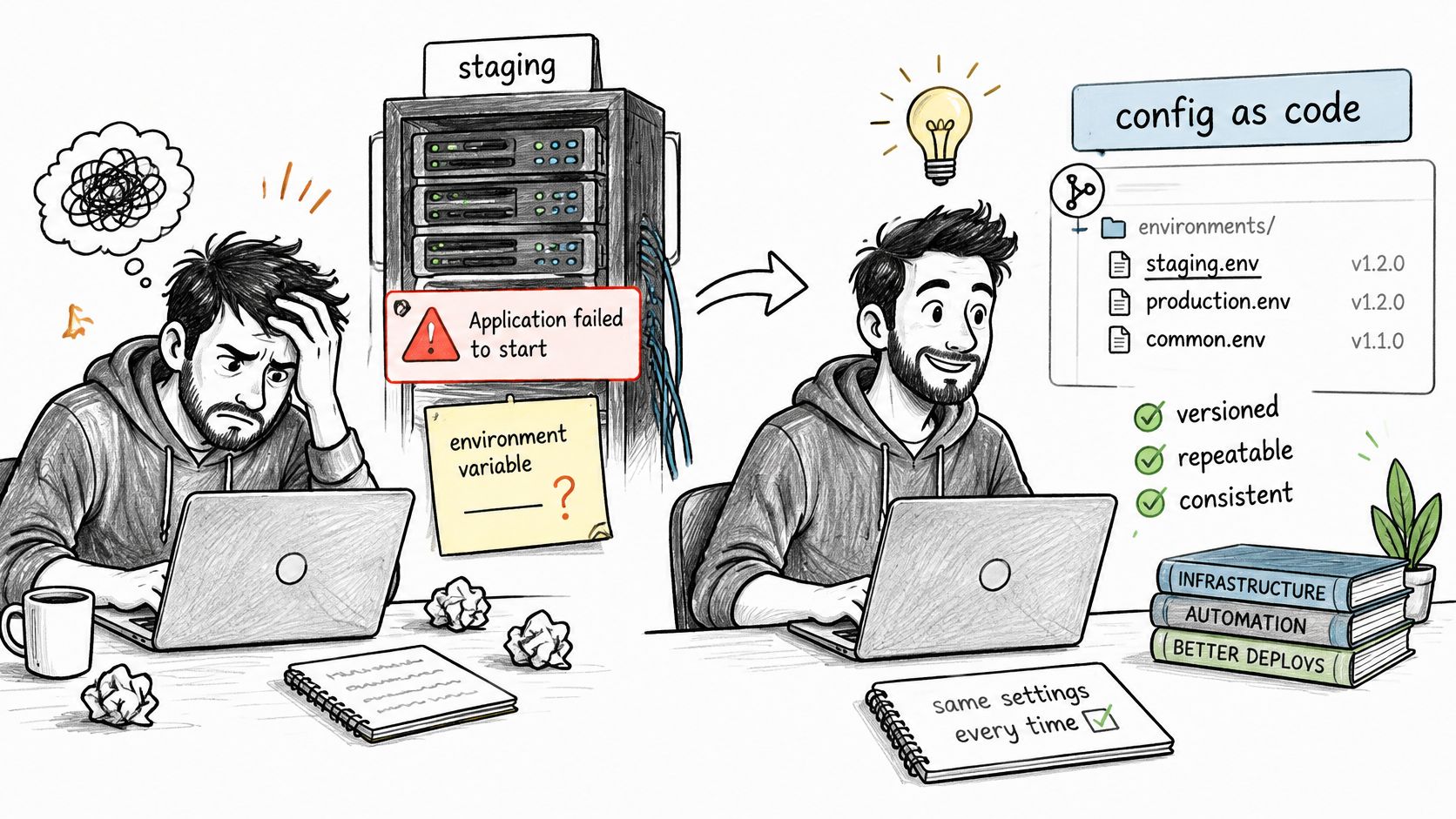
From instructions to controlled convergence
In a declarative workflow, you describe a desired state: a database exists, an application receives a connection reference, and a service accepts traffic on its intended port. The tool inspects what's running, compares it with that declaration, and applies the necessary changes.
That process is controlled convergence, bringing the actual environment toward an agreed baseline. NIST's configuration-management guidance recommends centrally established baseline configurations applied through automated tools, scripts, or vendor mechanisms.
Not every tool continuously compares live state, and some automation runs imperative instructions rather than declaring outcomes. The useful test is simpler:
- Written: Are the settings represented as text rather than someone's memory?
- Versioned: Can you inspect and review their history?
- Applied: Does automation execute the configuration instead of an operator recreating it manually?
Where the terminology fits
In Gofore's 2025 Cloud Project Radar, infrastructure as code appeared in 94% of projects surveyed, and Terraform was used in 40% of projects. Separately, Firefly's 2025 reporting reported that 59% of organizations used CI/CD or GitOps pipelines to deploy infrastructure.
Infrastructure as code provisions resources such as networks and databases. Configuration management establishes machine state, while GitOps describes a repository-centered operating workflow, often for clusters. Config as code is a useful umbrella for these related practices, not a claim that they all work identically.
Config as Code Benefits and Tradeoffs to Weigh
Config as code pays off when environments repeat and changes need review. It delivers less value when nobody owns the review queue, failed deployments, or differences between declared and live state.
A shared configuration removes opportunities for hand-built differences, but it also makes mistakes repeatable. Use a common baseline with explicit environment-specific inputs, not identical production and development credentials.
Config as code benefits and the tradeoff each carries
| Benefit | How it works | Tradeoff to weigh |
|---|---|---|
| Reproducible environments | One file is applied to development, testing, and production | A syntax or assignment error can reach every environment if rollout gates don't catch it |
| Review before effect | Every change arrives as a diff another person reads | Review capacity becomes a bottleneck, and an unreviewed merge restores the old risk |
| Auditable history | Each intended change is a commit with an author and date | Console, CLI, and SDK edits don't automatically appear in that history |
| Predictable recovery | Reapply the baseline or revert the offending commit | Recovery covers only described resources and doesn't automatically restore lost data |
| Idempotent convergence | Reapplying the same configuration produces no new changes | Drift still needs detection, classification, and reconciliation |
The costs aren't just technical
Reviewers need enough context to recognize an unsafe change. A clean diff that adds a database can still introduce an unjustified recurring expense, and a syntactically valid permission can still grant excessive access.
Secrets introduce another tradeoff. Copying a password into a reusable declaration can distribute that credential wherever the configuration travels, including repository history.
Adoption rule: Start where one team owns both the repository and the on-call response. Don't automate a wider rollout until review and drift checks have named owners.
The benefit is conditional: automation makes a well-governed process repeatable, but it can repeat a poorly governed process just as faithfully.
Which Tools Run Config as Code at Each Layer
The tool you need depends on which layer you're trying to control, not which configuration language you prefer.
Config as code tools by share of practitioners, 2019
The figures below are adoption among respondents in Guerriero and colleagues' 2019 practitioner study, not current market shares; the same study found that 69% of participants used three or more tools.
| Tool | Primary scope | Share of respondents |
|---|---|---|
| Docker | Containers and templating | 59.0% |
| Ansible | Configuration management | 52.2% |
| Kubernetes | Container orchestration | 40.9% |
| Chef | Configuration management | 36.3% |
| Terraform | Infrastructure provisioning | 34.1% |
| Puppet | Configuration management | 29.5% |
| CloudFormation | Cloud resource provisioning | 20.0% |
Read the scopes before choosing a tool
Docker helps define how an application is packaged and run. A Dockerfile can describe an image's build steps, while associated configuration supplies runtime settings. That doesn't make Docker a replacement for a cloud provisioning tool.
Ansible, Chef, and Puppet operate in the configuration-management layer. They can establish machine settings such as installed packages, service configuration, and operating-system policies. They're relevant when you manage the machine rather than treating its image as disposable.
Kubernetes describes and manages container workloads. You might declare a Deployment, its resource requests, and the configuration references it consumes. Those declarations don't necessarily create the external database the workload connects to.
Terraform and CloudFormation describe infrastructure resources. They can provision the database, network, and related access configuration, while application and machine tools handle other parts of the environment.
One project can cross every boundary
Say a Next.js application runs in a container and uses a managed database. The project may need an image definition, workload configuration, infrastructure declarations, and application environment settings.
The operational challenge is deciding which tool owns which property. If Terraform and another controller both try to manage the same setting, one may undo the other's changes. If neither owns database deletion, a discarded preview application can leave its database running.
Record those boundaries explicitly:
- Provisioning owner: Which declaration creates and deletes the resource?
- Runtime owner: Which system updates the application's live settings?
- Access owner: Who issues, rotates, and revokes credentials?
- Cost owner: Which team accepts ongoing usage?
Before choosing another tool, list the configuration files already in your project. Tag each with its layer and owner, then look for gaps and competing declarations. That exercise is often more useful than replacing a tool because another has more attractive syntax.
How a Config Change Moves From Repository to Live System
Suppose a Next.js project needs a DATABASE_URL environment variable. The repository should record the variable's name and secret reference, not the connection string containing a password.
This diagram gives the broad change path. Treat its stored environment value as a reference or placeholder, never a real credential.
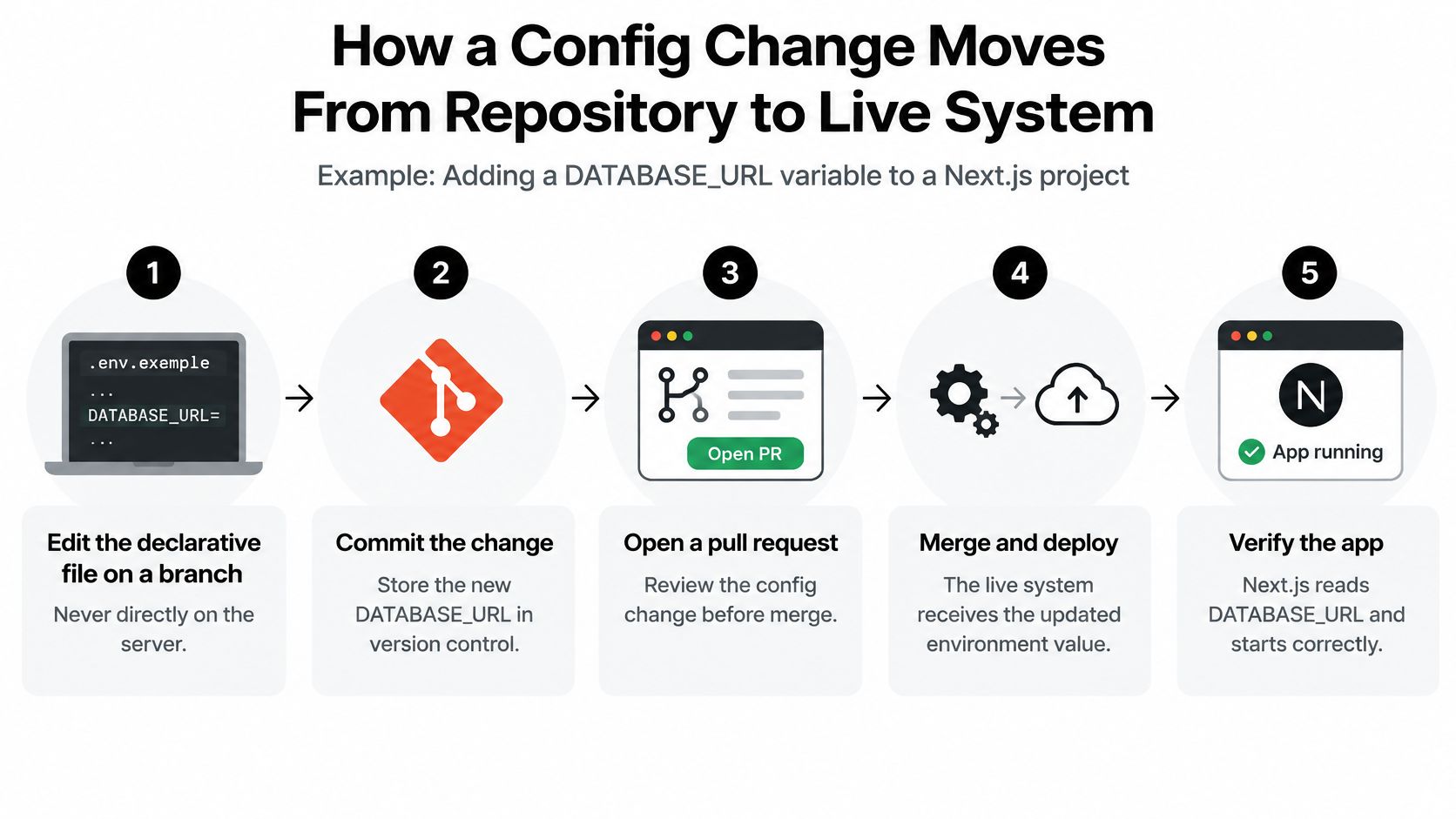
Move the change through explicit gates
Edit the declaration on a branch. Add the
DATABASE_URLbinding to the application's deployment configuration, pointing at the target environment's secret. Editing the server directly might fix today's failure, but it leaves the next deployment unable to reproduce the fix.Commit and open a pull request. Explain why the application needs the connection and which environment should receive it. A reviewer should inspect the diff and its intended effect, rather than approving a generic configuration update.
Run a plan or dry run. Inspect what the tool intends to create, update, or delete, including any replacement of existing resources. Skipping this step can hide a database replacement behind an innocent-looking configuration edit.
Merge only after approval. The approved commit becomes the desired version for that deployment target. Don't allow an unrelated manual deployment to race the merge and leave operators uncertain which version is live.
Apply through the pipeline. The deployment identity retrieves the required secret through the approved credential mechanism and supplies it to the application. Don't print the resolved connection string in build output or commit generated environment files.
Verify and reconcile. Check that the application connects successfully, then compare the managed live settings with the approved declaration. A successful deployment command isn't proof that the application works or that no settings were changed afterward.
Check the application boundary too
For backend application development, a configured variable is only part of readiness. The application also needs the expected database permissions, network access, and schema compatibility.
Repository-driven workflows are well established: Octopus Deploy's State of GitOps report, based on 660 survey responses and expert interviews, reported that 73% of organizations used GitOps for application configuration in 2025.
For another view of the workflow, use the accompanying video.
A healthy run leaves a plan consistent with the diff, an approved merge, evidence that the application works, and a reconciliation report without unexplained differences.
Checks Every Configuration Should Pass Before It Ships
Treat configuration as an input to your software supply chain, not a lower-risk substitute for application code. It can change access, availability, data retention, and spending without changing a line of business logic.
The empirical study of infrastructure-as-code defects identified syntax and configuration-assignment errors as the dominant defect category. That's a reason to validate both structure and meaning, not merely check that a file exists.
Use this visual as a summary of the acceptance gate, then apply the operational checks below.
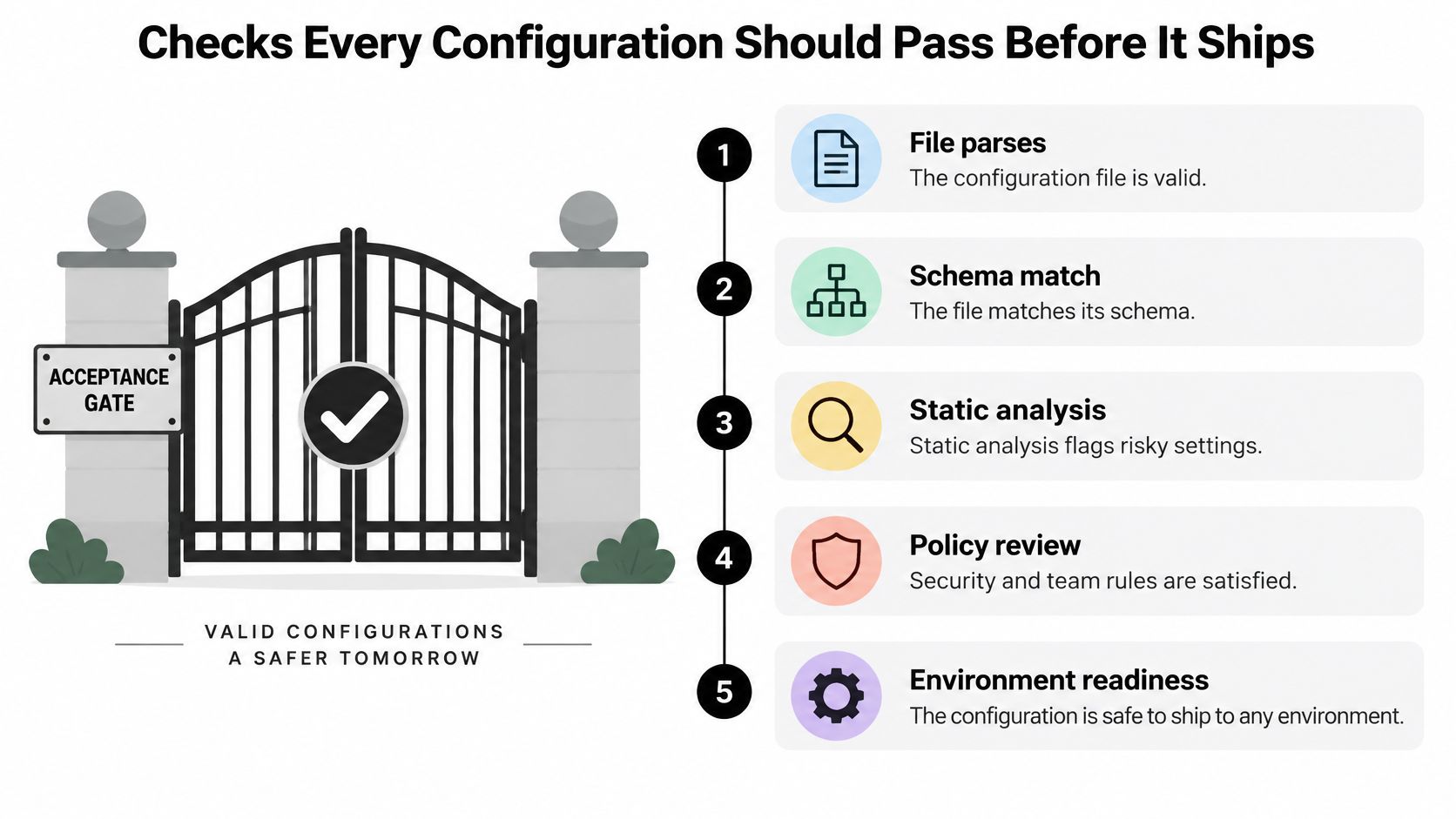
A release-blocking checklist
- Parsing and schema validation pass. Reject malformed YAML, unknown fields, and a port written as a nonnumeric value. A parser catches broken structure; a schema catches values that don't belong there.
- Static analysis finds no unresolved risks. Inspect suspicious assignments, public exposure, and insecure defaults. A valid file can still contain an unintended wildcard permission.
- A second reviewer approves the intent. Ask whether the service needs the requested capability, not just whether the syntax looks familiar. This catches a legitimate resource added to the wrong environment.
- The plan matches the request. A variable-binding change shouldn't unexpectedly delete storage. Investigate replacements and deletions before approving execution.
- Repeated application is safe. Test idempotency by checking that reapplication doesn't trigger unintended mutations. A generated value that changes on every run can produce unnecessary replacements.
- Secrets and permissions pass inspection. Reject a database password pasted into YAML and require access scoped to the machine or resource that needs it. Guidance on secrets in AI applications is especially relevant when agents generate configuration.
- Rollback or deletion is documented. State how to undo the change, who may execute that action, and what data could be lost. Reverting configuration isn't the same as reversing a database migration.
Validate changes throughout their lifetime
Configuration-data problems can persist through later edits. A declaration that passed validation when introduced may become unsafe when someone changes its inputs, provider assumptions, or surrounding resources.
Run the gates on every proposed change, and retain the reviewed plan alongside the deployment outcome.
Release gate: If a check fails, correct the declaration before production deployment. A server-side workaround doesn't make the repository safe.
Who Owns Drift When Config as Code Falls Short
Version control is not proof of operational control. It records intended changes that pass through the repository, not every action someone takes against a live resource.
Drift occurs when a console edit, CLI command, SDK call, or emergency intervention leaves the running system different from its declaration. A responder might temporarily increase capacity during an incident and forget to update the code afterward.
Firefly's 2025 State of IaC survey found that fewer than one-third of organizations continuously monitor drift and remediate it proactively, while 17% reported no drift-detection process.
Assign the decision, not just the alert
Before enabling reconciliation, answer these operational questions:
- Ownership: Who investigates a change made outside code?
- Detection deadline: How soon must the team discover a difference, given its security and availability consequences?
- Disposition: Which differences are permitted exceptions, and which require restoration?
Automatic correction without those decisions can undo an incident response or delete something valuable. Detection and safe repair are separate responsibilities.
Classifying a change made outside the code
| Class | Example | Response |
|---|---|---|
| Approved | A hotfix applied during an incident and logged in the change record | Record an exception with an owner and expiry date, then commit it to code before expiry |
| Forbidden | A public security group opened from the cloud console | Revert to the declared baseline in the same pipeline run through a tested remediation path, and alert the resource owner |
| Importable | A database created by hand during a migration | Bring the resource under code with an import, then apply a reviewed plan |
| Unclaimed | A changed setting with no matching ticket, commit, or owner | Quarantine the resource and escalate to the owner recorded in the metadata |
Make the response enforceable
Put owner, project, and lifecycle metadata on resources when you create them. An unclaimed operation may have no identifiable actor, but the affected resource should still have an accountable team.
Give every approved exception an expiry date. For importable resources, set a team deadline, such as the next sprint, and verify that importing the resource won't cause an unintended replacement.
Quarantine should mean restricting unsafe access or further changes according to a documented procedure, not blindly shutting down a production dependency. Preserve evidence before modifying a suspicious resource.
Every live change needs an attributable actor, a safe reversal or recovery path, and an accountable budget owner.
Keep operation records that connect identity, resource, credential, policy decision, and outcome. Resource lifetimes, revocation, secret rotation, and spending limits then become part of the same lifecycle, rather than unrelated administrative chores.
The important question isn't whether you can write infrastructure configuration. It's whether your team can explain and safely resolve what's running now.
Autonomous Agents and Who Authorizes Infrastructure
The classic workflow assumes a human writes configuration, another human reviews it, and an authorized deployment process executes it. Autonomous coding agents change the starting point: they can inspect an incomplete project, infer missing services, and request infrastructure while implementing an application.
The matched agent–human Terraform pull-request study found that agents created new infrastructure more frequently than humans, while the measured sustainability-smell introduction was statistically similar. That finding doesn't establish equivalent overall quality or security. It highlights why expanded infrastructure scope requires explicit authorization, even when the code looks reasonable.
The distinction is between helping an agent complete a project and allowing it to make persistent operational commitments.
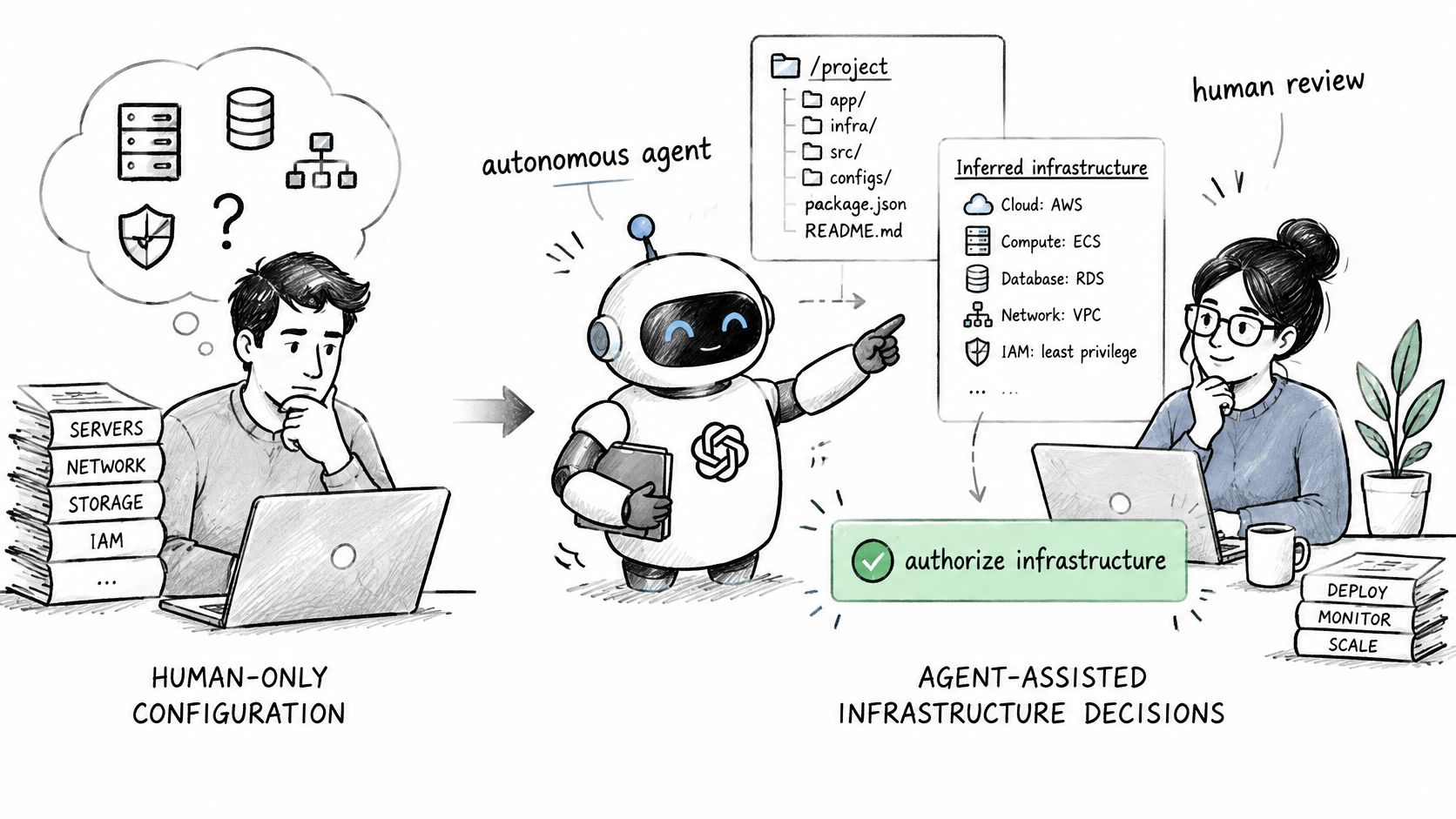
Project requirements aren't production permission
Our requirement-detection process starts with the project itself. We match exact catalog variable names in .env.example, .env.sample, or .env.template first, then inspect empty or placeholder values in .env or .env.local, and finally variable names referenced in source code.
That ordering helps distinguish an explicit project requirement from a guess. It doesn't establish that the requested service is approved for sensitive data, unlimited spending, or permanent operation.
When evaluating autonomous agent examples, ask who grants authority at each transition:
- Unclaimed project: Restrict provisioning to approved service types and bounded experimental allowances.
- Machine identity: Give each agent or machine its own scoped credentials, separate from human membership and billing seats.
- Temporary environment: Attach an expiration deadline and test the deletion path before relying on automatic cleanup.
- Production promotion: Require a human to approve persistent resources, the budget owner, and the intended access model.
Treat generated configuration as a supply-chain input
Agent-authored Terraform should enter through the same validation, policy, and plan-review gates as human-authored Terraform. Don't weaken those controls because the agent also generated tests or explained its reasoning.
Record the agent identity and version, the initiating task, the proposed resources, and the authorization decision with the pull request. During execution, preserve the machine identity and provider result so a reviewer can reconstruct what happened.
Spending limits and least-privilege credentials should constrain execution independently of the agent's instructions. A prompt asking an agent to be careful isn't an authorization boundary.
The goal is useful autonomy within a defined operating envelope. An agent can discover a missing database without receiving unrestricted authority to create permanent infrastructure.
Start Your First Config as Code Change
Choose a frequently changed service setting, such as a database connection binding or feature flag. Pick something whose owner and intended behavior are already clear, rather than beginning with a production migration.
Keep the first change narrow
Write the declaration. Put the nonsecret setting or secret reference into a versioned file. Describe the intended environment and make exclusions for generated credential files explicit.
Preview the effect. Running
npx extraorbital provision . --dry-runpreviews the plan without creating resources or writing project files. Oursnippetscommand needs no account, so you can also inspect setup code for a supported platform before connecting anything.Compare and review. Read the proposed actions against the declaration, then submit the change through a pull request. Stop if the plan includes an unexplained resource, replacement, or deletion.
Assign the lifecycle. Name the resource owner and set an expiry date for temporary infrastructure. Record who receives failures and who may approve making the resource permanent.
Don't expand immediately across every environment. First confirm that your team can explain the plan, execute it safely, and account for the resulting live resource.
First-change boundary: Use a single repository and a single layer until the review and ownership process works.
Schedule a monthly drift review as a backstop, with more frequent or continuous checks wherever the risk requires them. Keep secrets outside versioned files, and distinguish a routine configuration rollback from data recovery.
This week, write the declaration for a service you already understand and compare its plan with what's running.
ExtraOrbital reads project requirements, provisions missing supporting services, and writes connection details where application code expects them. Visit ExtraOrbital to inspect the project-based workflow, starting with a dry run before authorizing infrastructure changes.