Autonomous Agents Examples: 8 That Actually Deliver
Real autonomous agents examples across coding and beyond, with tactical insights and actionable takeaways for putting each one to work in 2026.
Nearly every organization runs AI. Very few run agents. Stanford's 2025 AI Index found that 78% of surveyed organizations reported using AI in 2024, up from 55% in 2023, yet scaled agent use stayed in the single digits across nearly every business function, with technology the outlier at 24% in software engineering, 22% in IT and 21% in service operations (Stanford 2025 AI Index).
The gap isn't intelligence. It's scaffolding. An agent that plans, calls tools and modifies systems needs a sandbox, scoped credentials, a test suite and a review gate before it's worth trusting with anything real.
The eight autonomous agents examples below are dissected the same way: how each one works under the hood, where it earns its keep, where it breaks, and one operating strategy you can copy into whatever agent you adopt next. One failure pattern shows up in all eight, and it rarely involves reasoning. The workflow stalls on a missing database URL, an expired API key, or a repository that won't build.
1. Devin (Cognition)
Cognition shipped Devin in March 2024 and called it an AI software engineer. The label stuck because the product was packaged as a delegate rather than an autocomplete: a sandboxed machine with its own shell, code editor and browser, where the agent plans a multi-step task, writes code, runs the tests, reads the failures and iterates before handing work back.
That packaging is the useful idea. Older tools put tokens at your cursor. Devin owns a task.
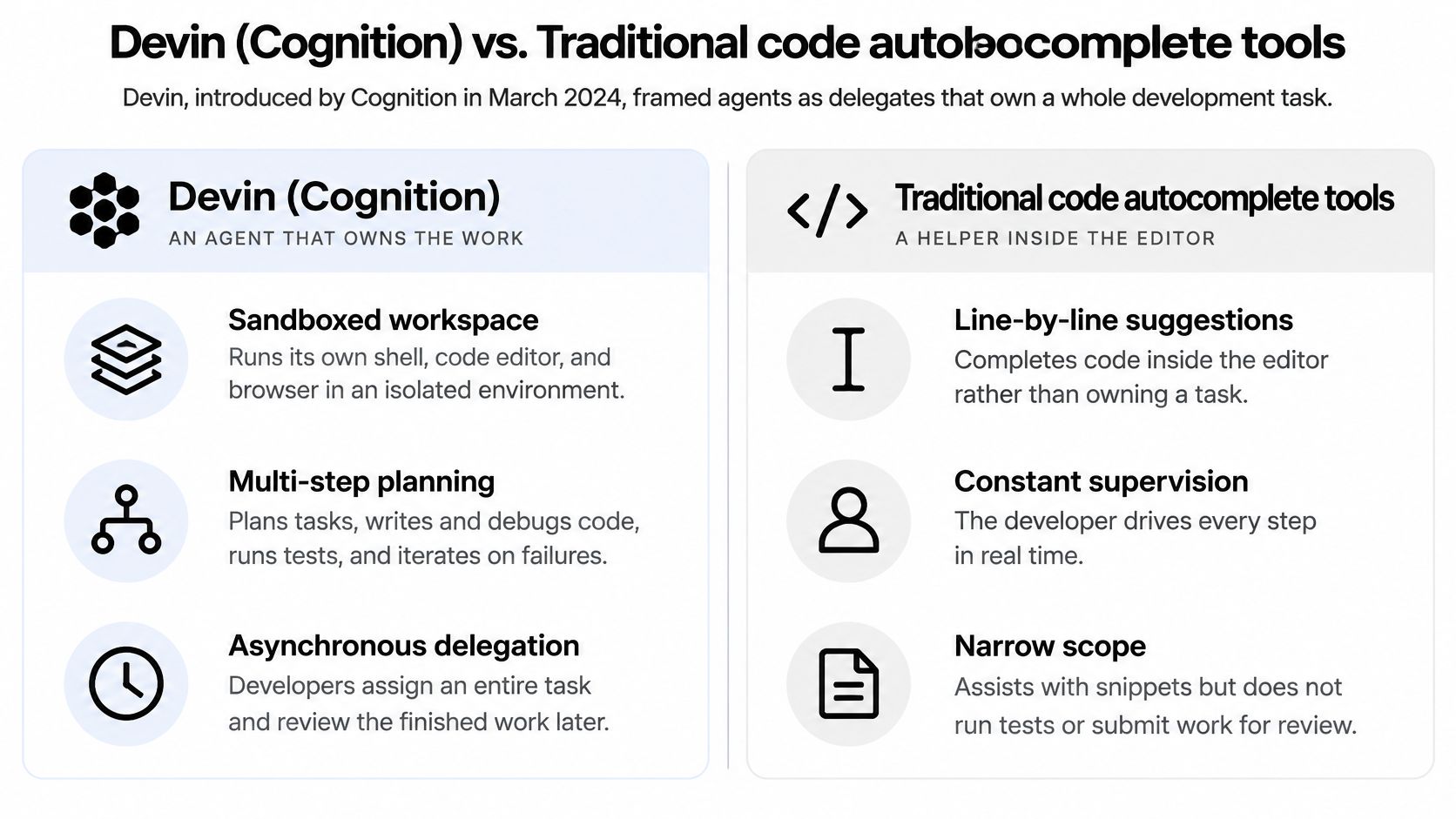
What the environment decides
A delegate is only as good as the machine it stands on. Devin can run a test suite, but it can't conjure the Postgres instance that suite expects, and it can't guess what STRIPE_SECRET_KEY should be. Watch a novice run it and you'll see twenty minutes of confident edits followed by a container waiting on a connection string.
Where it earns its keep is work with an executable definition of done: framework migrations, dependency upgrades, bug fixes already covered by a failing test. Hand it one of those and the repository tells the agent when it's finished.
Where it breaks is anything ambiguous. Give it "improve the checkout flow" and you'll get plausible edits you have to read line by line, which costs more than writing them yourself.
Practical rule: If you can't express the finish line as a command that exits 0, the agent will invent its own finish line, and you won't like the one it picks.
- Write the definition of done as tests first. Point the agent at the specific suite that must pass, not at a paragraph of intent.
- Provision dependencies before the agent starts. Databases, queues and keys should exist the moment the task begins. A backend application development workflow that expects the agent to stand up its own services stalls at the first connection error.
- Review in small pull requests. One task, one branch, one reviewable diff.
2. OpenHands (formerly OpenDevin)
OpenHands started as OpenDevin and renamed itself once the scope outgrew a single-vendor clone. It's an open-source platform for running software development agents, and the agents work inside a Docker sandbox where they can edit files, run shell commands, browse the web and talk to repositories.
The difference from a hosted product is inspection. You can read the runtime, change the tool definitions, and trace exactly which command produced which file.
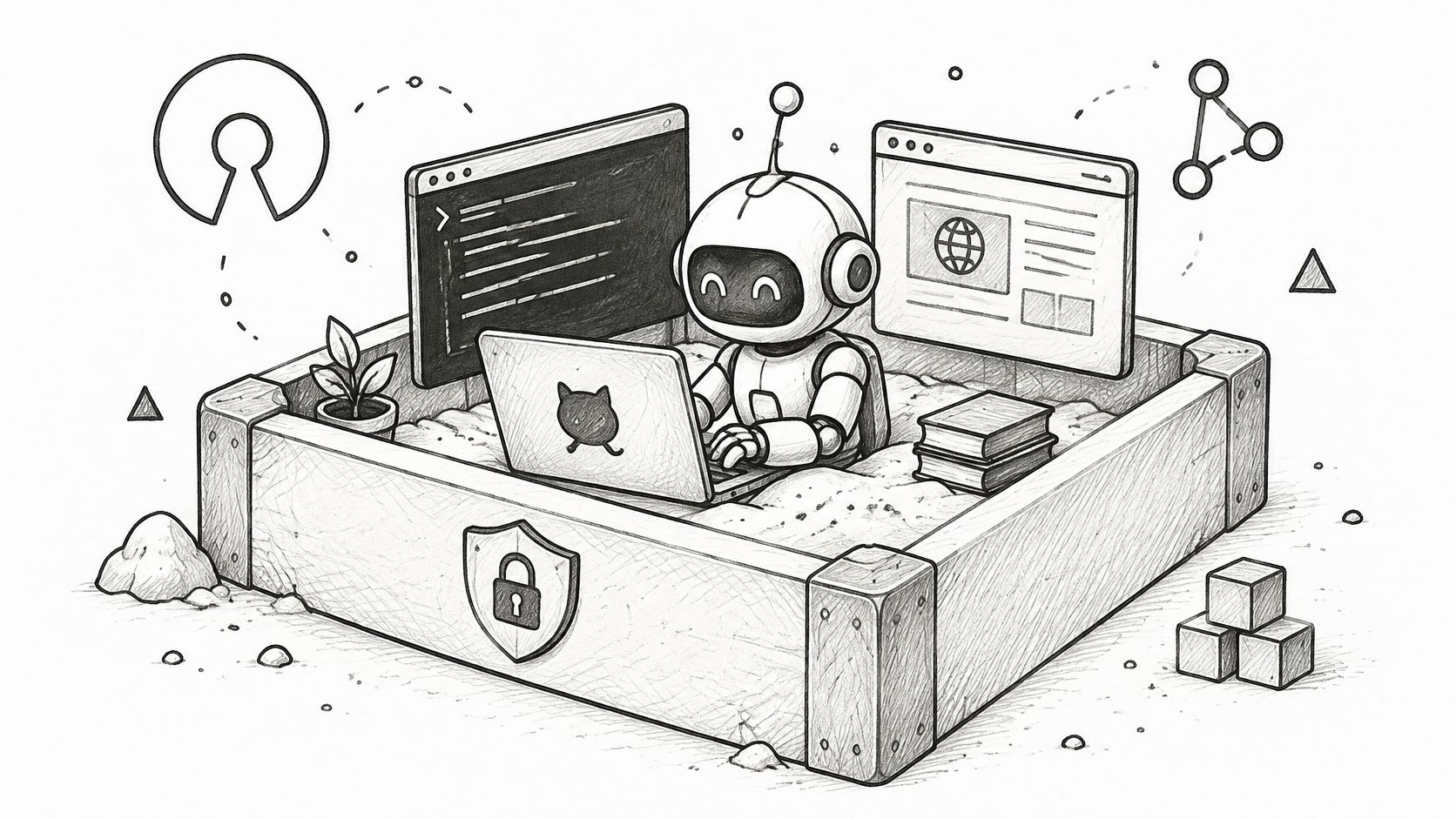
Why self-hosting changes the risk math
A hosted agent asks you to trust its sandbox. OpenHands lets you build the sandbox, which matters when the agent's blast radius is your cloud account. Research groups use it to reproduce issue-resolution experiments. Platform teams use it as a reference architecture for internal agents, because the runtime, tool layer and event stream come apart cleanly.
The failure modes are operational, not intellectual. Containers get reused across tasks and leak state. Agents inherit a developer's whole environment file because it was mounted for convenience. Long runs chew through tokens with nothing to stop them.
- Start from a clean container per task. Reuse is where cross-task contamination happens.
- Inject only what the task needs. A task that edits CSS doesn't need a production database URL or a cloud token.
- Rotate secrets at phase boundaries. If a key went into a container, treat it as exposed once the task ends.
- Cap runs in tokens and wall-clock time. A container that runs all weekend is a bill, not a result.
A worked example: point OpenHands at a documentation repo to fix broken links. That task needs no database, no cloud key and no network write access, so the container gets none of them. The agent stays useful and harmless in the same run.
3. SWE-agent
The interesting thing about SWE-agent isn't its leaderboard position. It's the interface. Researchers at Princeton and Stanford built an Agent-Computer Interface, a small set of commands designed for a language model to explore a repository, open files, edit them and run tests, instead of handing the model a raw shell and hoping.
That decision is the lesson. A model with an unbounded shell has to discover how to be careful. A model with five well-named commands gets guardrails for free.
What the benchmark record actually says
Repository-level agents went from roughly 4% issue resolution in 2024 to approximately 40% to 50% on real GitHub issues in 2025, according to this case study of autonomous coding agents. That's a genuine jump, and it still isn't production reliability. Success depends on repository setup, test quality, environment reconstruction and whether the requirement was ever unambiguous.
Where it shines is a clean repo with a trustworthy suite and a crisp issue. Where it fails is a monorepo with flaky tests and no environment file, because the agent spends its budget rebuilding an environment instead of fixing a bug.
Design simple, focused tools for the agent instead of exposing a full shell by default. Constraint is a feature.
A practical run: take three closed issues from your own tracker, replay them in a sandbox with the environment pre-built, and count how many the agent solves without touching files the issue never mentions. That number, not a public benchmark, tells you whether to trust it.
- Log every command. The trajectory is your audit trail when a run goes wrong.
- Benchmark small before production. One sandbox repo, ten issues, one afternoon.
- Pre-build the environment. A SQL database creator step in your setup script beats a forty-minute debugging detour inside the agent loop.
4. AutoGPT
AutoGPT is the reason your product manager has an opinion about agents. Toran Bruce Richards released it in March 2023, and it demonstrated something new at the time: model output feeding back into itself as a loop, with the agent setting sub-goals, calling tools such as web search and file writes, and grading its own progress toward a stated objective.
Under the hood there's no magic. It's a prompt loop with a scratchpad, a tool list and a stopping condition. The agent writes a plan, picks a command, executes it, appends the result to memory, and repeats until it decides it's finished.
Where the loop still earns its place
Not on open-ended ambition. On narrow chores with a human at the end: gathering sources on a topic, drafting an outline from collected notes, summarizing a batch of documents into a first pass you'll rewrite anyway.
Where it fails, and fails loudly, is an objective like "grow my newsletter" with no spending cap and no write confirmation. The loop will happily send emails, create files and burn tokens. Self-evaluation is optimistic too. An agent grading its own homework almost always passes.
The narrow-goal test: if you can't state the finish condition in one sentence and verify it in one command, the loop will still run and produce something, and "something" is the most expensive output in software.
- Set iteration and spend limits before the first run. Hard numbers, enforced by the harness rather than the prompt.
- Pause before any write, send or purchase. Reads can be autonomous. Side effects need a human.
- Keep goals boring. "Summarize these twelve URLs into a table" works. "Research the market" doesn't.
5. GitHub Copilot Coding Agent
GitHub's coding agent uses the most conservative architecture in this list, which is often the key advantage. Announced in 2025, it is assigned an issue and operates within a secure GitHub Actions environment. It explores the repository, makes changes, runs tests and linters, and opens a pull request for review.
Nothing about it is exotic. That's why it lands in teams that would never approve a rogue shell.
Where it fits into an existing review process
Say a payments service has an open issue about a missing null check, plus a test that should prove the fix. Assign the issue, and the agent returns a branch and a pull request that runs your existing CI. Branch protection, CODEOWNERS and review rules apply automatically, because the output is a pull request rather than a surprise commit.
Where it breaks is issue quality. An issue without acceptance criteria or file paths gives the agent latitude, and it spends that latitude on the wrong file. Secret scoping is the second failure: an agent environment holding the production deploy key can, in principle, use it.
The evaluation gap sits underneath both. A review of 15 agent benchmarks found that all 15 omitted safety scoring, all omitted cost tracking, 14 failed to measure trajectory quality, and 13 relied mainly on binary success metrics, according to this benchmark review in Artificial Intelligence Review. Independent DevOps testing in the same review found the strongest agent succeeded on only 51.85% of build-and-configuration tasks, 20.56% of monitoring tasks, 23.87% of issue-resolution tasks and 13.87% of test-generation tasks.
Translation: a passing CI run says the diff compiles. It doesn't say the agent took a safe route to get there.
- Write issues with explicit acceptance criteria and relevant file paths.
- Scope environment secrets to the minimum the task needs.
- Require human review plus passing CI before merge, with no exemption for trivial diffs.
6. Cursor Background Agents
Cursor's background agents move the work off your machine. Each agent runs asynchronously in a remote environment cloned from your repository, and you can start several in parallel, one per branch or task, then review diffs when they finish.
That's a different job than pair programming. You stop watching the model type and start triaging output.
The week-three problem
Parallel delegation is easy to start and hard to keep honest. Isolated tasks behave well. A refactor touching forty files over three weeks does not, because every change must preserve behavior your tests don't fully describe. A study of continuous software-evolution settings reported performance falling from above 80% on isolated tasks to no more than 38% where changes had to preserve system integrity across a commit history (study of agents in continuous software evolution). The same work reports an overall project-level acceptance rate of 27.38%, with failures clustering around specification alignment, edge cases, optimization and resource management.
The practical reading: background agents shine on work that's already sliced. Frontend components, test coverage, docs, mechanical renames. They wobble when a human hasn't decided the shape of the change yet.
Split by seam, not by size. Two agents editing the same file on different branches produce a merge conflict that costs more time than the parallel run saved.
- Give each agent non-overlapping files. Merge conflicts are the tax on parallelism.
- Make each remote environment self-sufficient. If a clone can't reach a database or a service credential without a human, the agent stalls at minute two and bills you for the wait.
- Set per-task spend limits before launching a batch. Ten parallel agents multiply every mistake by ten.
7. Manus
Manus launched in March 2025 from Butterfly Effect as a general-purpose agent that works in its own cloud environment rather than inside your application. It browses the web, writes and runs code, generates files, and delivers a finished artifact such as a report or a small site.
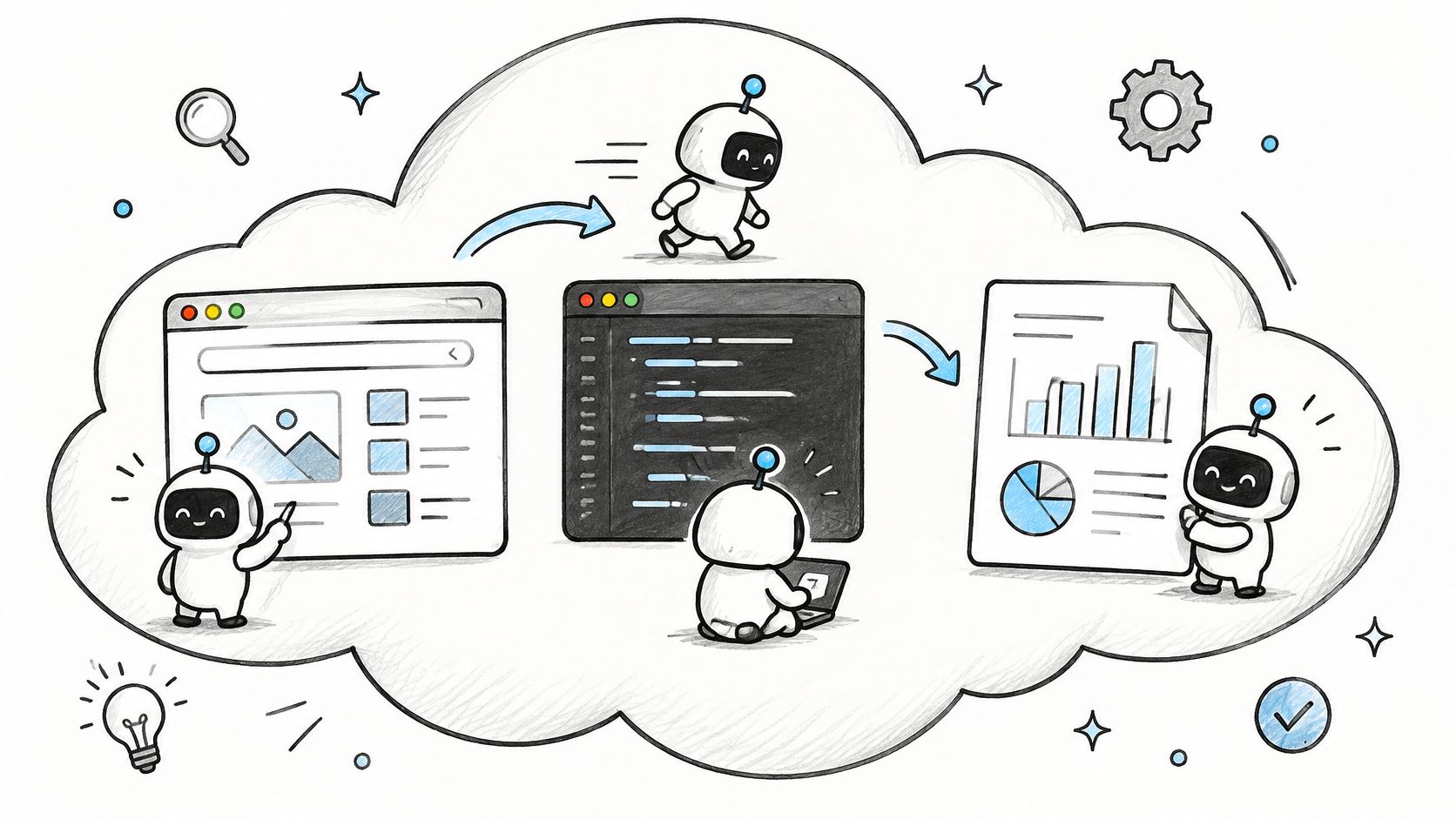
What a generalist buys and costs
The buy is breadth. One task can research six vendor pricing pages, build a comparison table and export a document, which is the sort of chore nobody wants to do by hand.
The cost is credentials and trust. A generalist needs broad access to make its breadth useful, and broad access is exactly what you shouldn't hand an agent that runs unattended.
Governance stops being paperwork here. An evaluated governance pipeline for autonomous agents achieved a 96.0% interception rate with a 16.0% false-positive rate, while adding roughly 980 ms median and 1,640 ms P99 end-to-end latency, per research on agent governance architecture. The intent-judgment layer dominated that latency at about 966 ms P50 and 1,622 ms P99, while immutable audit logging cost only about 16.5 ms P50 and 17.6 ms P99.
The design lesson is separation of speeds. Put credential scoping, machine revocation, budget checks and audit recording on every operation, because they're cheap. Reserve slow semantic judgment for production database changes, large spend and secret rotation.
- Review artifacts before they ship. A generated report or site is a draft until a human reads it.
- Use scoped, revocable access instead of long-lived keys.
- Break large objectives into milestones with named outputs.
A worked example: ask for a competitor pricing table and require the output as a CSV plus a list of sources. The artifact is checkable in a minute, and the browsing trail becomes reviewable evidence.
8. Project Mariner (Google DeepMind)
Project Mariner is a Google DeepMind research prototype that drives a browser on a user's behalf. It reads the screen, clicks, types, and works through multi-step web tasks such as product research or filling a form.
The significance is architectural. Every other agent in this list needs an API, a repository or a sandbox. Mariner works on interfaces built for humans, which puts the long tail of software without an API in reach.
The reliability ceiling of computer use
Computer use is the hardest environment here because pixels lie. A button moves, a cookie banner eats a click, a page loads slowly. Stanford's AI Index reports that agent performance on OSWorld, a benchmark requiring agents to operate real computer interfaces across operating systems, rose from 12% task success to approximately 66% (Stanford AI Index). That's a milestone and a warning in the same sentence, because the same evidence shows agents still fail roughly one in three benchmark attempts.
An agent that completes a workflow most of the time is a demo. An agent you can leave unattended is a different product.
Where it shines is read-heavy, low-stakes research: comparing products, collecting public data, filling the same form on twenty sites. Where it fails is anything irreversible, which means purchases, deletions and account changes.
The DeepMind demonstration below shows the pattern in practice.
- Use a dedicated browser profile with no saved payment methods.
- Require explicit confirmation for purchases, deletions and account changes.
- Prefer an official API where one exists and treat browser automation as the fallback.
The 8 Autonomous Agents at a Glance
| Focus Area | Type | Deployment Model | Best For |
|---|---|---|---|
| End-to-end software development tasks | Autonomous coding agent | Sandboxed workspace | Delegating well-scoped coding tasks for later review |
| Open-source software development agents | Open-source coding agent platform | Docker sandbox; self-hosted or managed | Teams building customizable, auditable development agents |
| Resolving GitHub issues and evaluating agents | Research coding agent | Configurable, sandboxed research setup | Reproducible software-agent benchmarks |
| Goal-driven tasks using tools and memory | General-purpose autonomous agent | Configurable agent runtime | Prototyping agent workflows with bounded goals |
| Repository issues, code changes, and pull requests | Autonomous coding agent | GitHub Actions sandbox | Routine coding tasks within GitHub workflows |
| Parallel coding tasks and branch-based changes | Background coding agents | Remote, isolated environments | Running multiple development tasks in parallel |
| Cross-tool research, analysis, and file creation | General-purpose autonomous agent | Cloud-hosted environment | Delegating multi-step tasks that produce tangible deliverables |
| Completing tasks through browser interaction | Browser-use research agent | Research preview with user supervision | Web tasks on sites without suitable APIs |
Choosing and Running Your First Autonomous Agent
Eight agents, one pattern. The ones that deliver share four properties, and none of them are model choice.
- A task with an edge. Migrations, test additions, dependency bumps, research reports. Not "improve the product."
- An environment that already exists. The database, queue, bucket and keys are live before the agent's first command.
- A finish line a machine can check. A test suite, a linter, a schema validation. Not a paragraph of intent.
- A review gate before merge or deploy. A pull request a human reads, with the agent's command log attached.
The most common failure pattern isn't a bad plan. It's an agent that stops at a connection error because the database was never created, or finishes with a hard-coded key because nobody provisioned a real one. Fix that layer and the same model suddenly looks far more capable, because it was never the reasoning that was holding you back.
That gap is what ExtraOrbital targets. Its command-line tool reads a project's requirements and provisions the missing databases, storage, auth and AI services with one command, without separate provider accounts, and an agent can begin in a free sandbox before a person claims the project and adds billing. Credentials stay scoped per machine and per resource, an immutable audit trail records every operation, and a machine can be revoked or a project's secrets rotated in a click.
Start with this sequence, and don't skip step three because it looks like the boring one.
- Pick one narrow workflow. A dependency upgrade, a test backfill, a broken-link sweep.
- Benchmark on ten real cases. Replay closed issues or finished tickets and count clean successes, not near misses.
- Provision dependencies automatically before the agent runs. Every stall you remove adds throughput without touching the model.
- Enforce review and passing CI before merge. No agent-authored diff lands unreviewed, including the small ones.
- Set spend and time limits per task. Caps turn an experiment into a controlled cost.
- Expire every temporary resource. Abandoned prototypes and forgotten databases are the quiet bill of agent-driven development.
ExtraOrbital provisions the infrastructure your agent needs before its first command, detecting a project's requirements and supplying the databases, storage, auth and AI services a workflow expects, with credentials written where your code already looks for them. Credentials are scoped per machine, every operation lands in an immutable audit trail, and revocation takes one click, so a stalled agent becomes a running one without widening access. Visit ExtraOrbital to run the provisioning command against your own project.