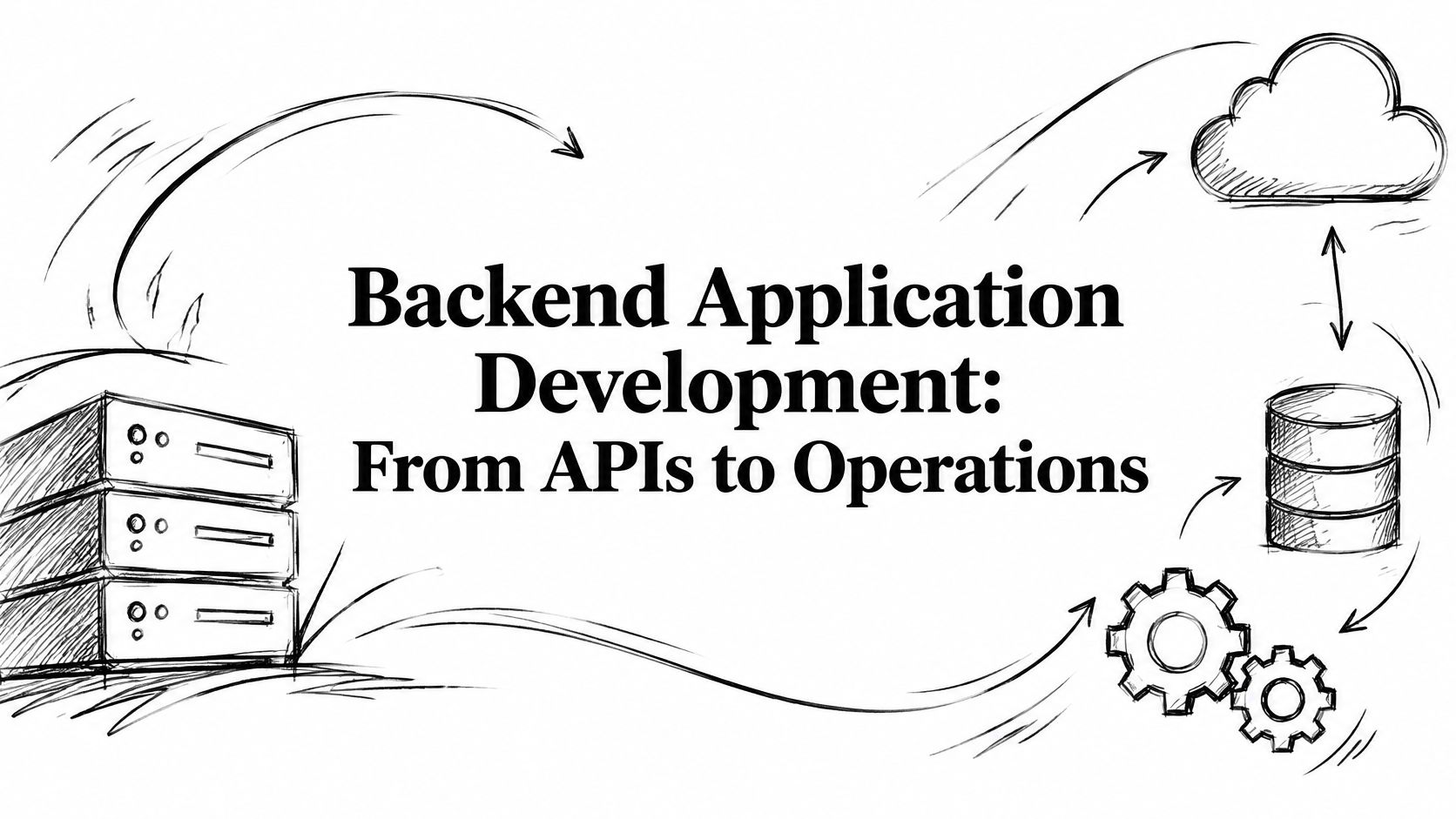
Backend Application Development: From APIs to Operations
Learn backend application development step by step, from APIs and databases to authentication, deployment and operations, with a lifecycle map for 2026.
You shipped the feature on Friday. The mobile build calls the new endpoint, and the demo looked solid. By Wednesday a renamed field has broken two client releases, and a test database from last month is still billing a card nobody checks.
That gap is what backend application development covers. The handler that returned success was the easy part. The contract, the stored data, the credentials, the running process, and the day you turn a prototype off are the job.
The Backend Lifecycle at a Glance
Think of the backend as the kitchen behind a restaurant counter. Guests never see the stock room or the sinks, but a wrong ticket or a dirty board still shows up on the plate.
Eight stages stay in view while you build: design the contract, model the data, build the API handlers, add authentication and authorization, test, deploy, operate, and retire. Each one forces a decision, leaves artifacts, and fails in a way teams already recognize.
| Stage | Key decision | Typical artifacts | Common failure |
|---|---|---|---|
| Design | Which resources exist and who calls them | API contract, sequence sketch | Contract changes after clients have shipped |
| Data modeling | Which store holds each entity | Schema, migration files | Unindexed queries slow down under load |
| API build | How to route, validate and respond | Handlers, validation rules | Inconsistent error formats across endpoints |
| Authentication | Who may do what | Token or session rules, role definitions | Authorization checked only in the user interface |
| Testing | What must never break | Unit and integration tests | Tests run against a database nobody else can reproduce |
| Deployment | Where and how the code runs | Container image, CI pipeline | Configuration differs between machines |
| Operations | How failures become visible | Logs, metrics, alerts, backups | Backups that have never been restored |
| Retirement | When and how resources end | Expiry dates, teardown list | Forgotten resources keep billing |
Language skill and data skill travel together. Stack Overflow's 2025 Developer Survey found JavaScript used by 66% of respondents, SQL by 59%, and Python by approximately 58%. Docker usage reached about 71% among cloud-development and infrastructure technologies, a 17-percentage-point increase from the previous year. That shift is from one app on a hand-managed server toward reproducible, containerized services.
Practical rule: Find the row where the project is stuck, and finish that stage before you add another endpoint.
How a Request Moves Through a Backend
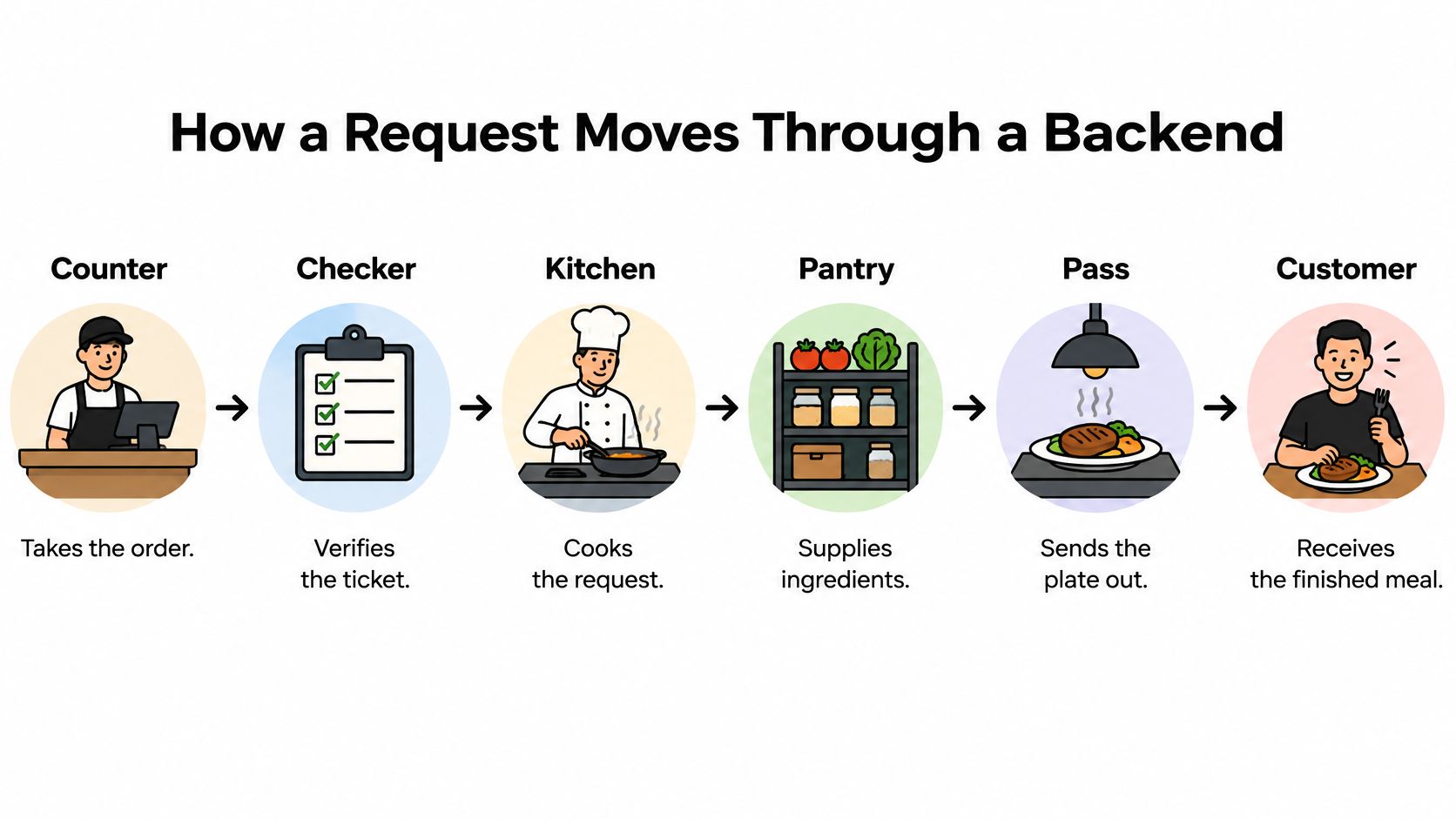
A request is an order ticket moving through that kitchen. The counter takes it, a checker verifies it, the kitchen cooks, the pantry supplies ingredients, and the pass sends the plate out.
The same path, drawn as a kitchen line, looks like this.
- The client sends an HTTP request with a method, a path, headers, and a body.
- The router matches that path and method to one handler.
- Middleware parses the JSON, verifies the token, and applies a rate limit.
- The handler applies business rules, such as refusing an order when stock is zero.
- The data layer reads or writes, for example an SQL insert inside a transaction.
- The handler returns a status code. 200 means success, 201 means created, 400 means bad input, 401 means unauthenticated, 403 means forbidden, 404 means not found, and 500 means a server fault.
- The logs record a request ID, the duration, and the outcome.
Say a checkout spends 40 ms in the handler and 900 ms waiting on the database. The fix is the query or a missing index, not another rewrite of the handler. A 4xx response points at the caller: bad input, a missing login, or a forbidden action. A 5xx response points at the server: an unhandled exception, a down dependency, or a bug in your code.
If you want the same walk-through as a short talk, this clip follows one request from the edge to the data store and back.
A failing request is traceable. Find the last step it reached, and that step is where you look next.
Choosing an API Style and Keeping It Stable
Many backends are not called by a browser alone. Other apps use each service through its SDK or API, so the contract matters as much as the code behind it.
| Style | Strongest when | Trade-off | Typical client |
|---|---|---|---|
| REST | Resource-based create, read, update and delete, and public APIs | Clients may over-fetch or under-fetch fields | Browsers, mobile apps, third-party integrations |
| GraphQL | Many clients need different field sets from the same data | Caching and query cost control are harder | Frontends with varied screens |
| gRPC | Internal service-to-service calls where latency matters | Limited direct browser support without a proxy | Microservices and background workers |
| WebSocket | Live updates flowing in both directions | Connection state must be managed on the server | Chat, live dashboards, collaborative editing |
Habits that keep any contract stable
Version in the URL or a header. Never change the meaning of a field in place. Add a new field, or ship a new version, and leave the old one alone until callers have moved.
Use one error shape. Every endpoint returns a code, a message, and the offending field. Mobile and partner teams can then parse failures without a special case per route.
Paginate with cursors. Offset paging gets slower as tables grow, because the database still walks the skipped rows. A cursor says "start after this id" and stays cheap.
Add idempotency keys on payments and orders. A retried checkout must not charge twice. Store the key with the result, and return the original result when the same key arrives again.
Validate at the boundary. Reject bad types, missing fields, and impossible amounts before business logic runs. A handler should not be the first place a string lands in a numeric column.
A mobile app pinned to version 1 of a shipping endpoint keeps working after version 2 renames a field, because the old field stays until that version is retired. Pick the style that matches your clients, then treat the contract as a promise you can't break.
Choosing and Running Your Data Layer
Default to a relational database unless the shape of the data clearly demands something else. Add a cache or a document store for a specific job, not as a substitute for a schema you haven't drawn.
In 2025, PostgreSQL was the database developers most wanted to use, with 47% selecting it for the coming year, according to Stack Overflow's 2025 Developer Survey. The usage column below is a respondent share, not a market share. Someone can report more than one database.
| Store | Best for | 2025 developer usage | Watch out for |
|---|---|---|---|
| PostgreSQL | Relational records, transactions, JSON columns | 55.6% used; 47% want to use it next year | Connection exhaustion without pooling |
| MySQL | Web applications with simple relational schemas | 40.5% used | Charset and strict-mode defaults |
| SQLite | Embedded apps, single-node services, prototypes | 37.5% used | Write concurrency on shared multi-instance servers |
| Microsoft SQL Server | Organizations already on Microsoft stacks | 30.1% used | Licensing costs |
| Redis | Caching, sessions, short-lived queues | 28% used | Data loss on restart without persistence |
| MongoDB | Flexible document-shaped data | 24% used | Schema drift without validation rules |
| Vector stores | Embedding search for AI features | Not broken out in the 2025 survey | Index rebuild time as data grows |
If you are still choosing the relational engine, start from the queries you must run, not from a brand preference. A focused SQL database creator walk-through is a useful checkpoint before the first migration file lands.
Habits that keep the store healthy
- Migrations as versioned files: Check them into the repo and run them in the deployment pipeline, in order, once per environment.
- Indexes for real queries: Add them for the filters and joins you ship, then read the query plan instead of guessing.
- Connection pooling: Each app instance should borrow from a pool. Dozens of direct connections per instance will exhaust Postgres under a small burst.
- Redis persistence when the cache must survive: Turn on the persistence mode you can restore from, or accept that a restart empties the store.
- Backups with a measured restore: Take them on a schedule and write down how long a restore takes. An untested dump is a hope, not a backup.
Say a sessions table lives only in Redis, and persistence was never enabled. A restart logs every user out at once, and support sees it as an auth bug. Ask three questions before you pick a store: what must the data survive, how fast must it be read, and who owns its schema?
Authentication, Secrets and Access Control
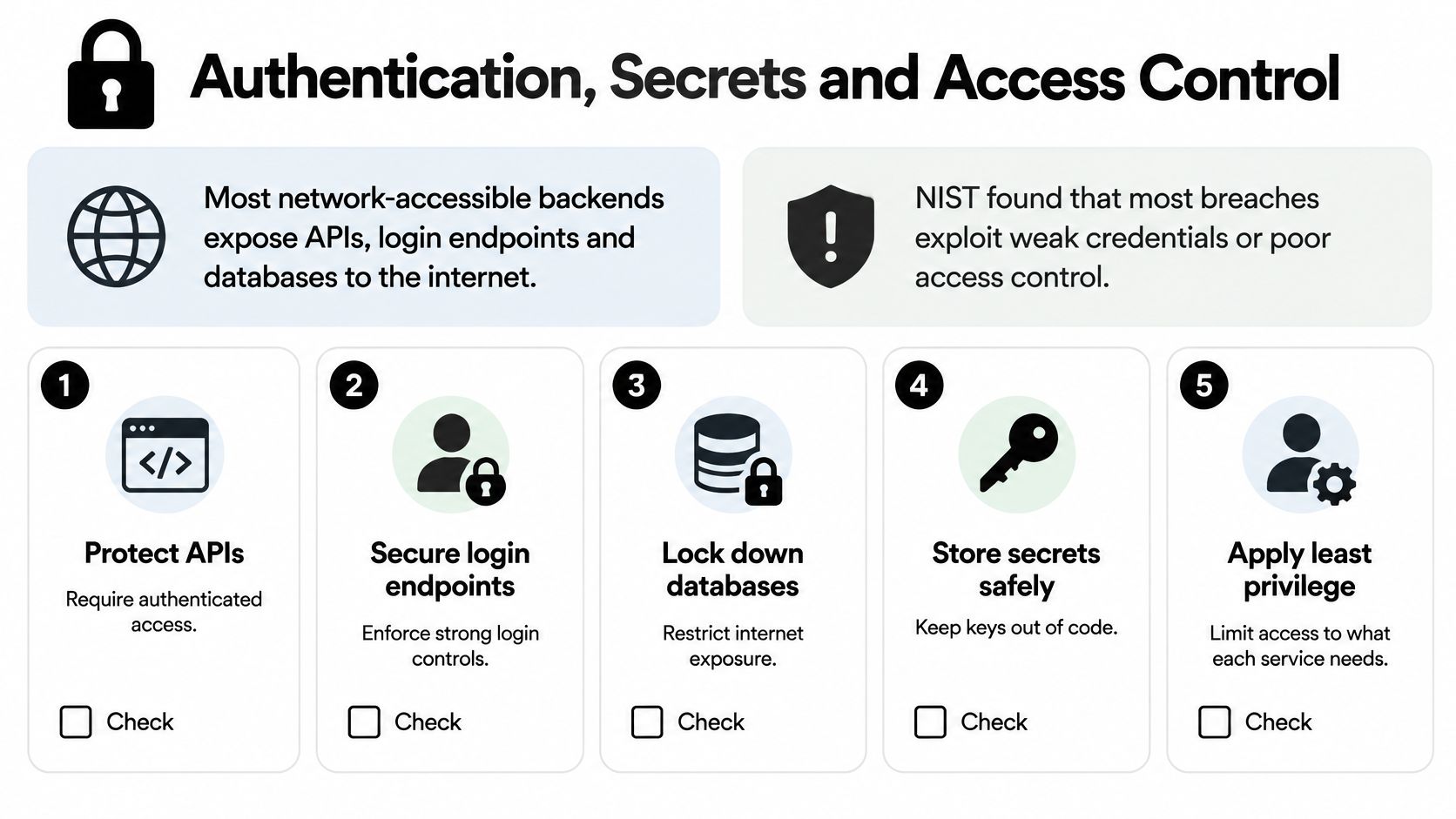
A login route, public API, or database port reachable over the internet can be probed by anyone who can send a request. Treat identity as something every request must prove, then treat permission as a separate check that happens after identity is known.
Sessions, tokens, and passwords
Server-stored sessions work like a coat check ticket: delete the row, and the next request fails because the ticket no longer matches anything. Signed tokens scale without shared session state, but revocation needs a denylist or a short lifetime, so decide how you will kill a token before you issue many of them. If your sign-in flow exchanges a code for tokens through ExtraOrbital, call that exchange from the app's server: its response has no CORS headers, and a browser page cannot read it.
Hash passwords with bcrypt or Argon2. Never store them in plain text, and don't use a fast general-purpose hash such as raw SHA-256. When users sign in with another provider, use OAuth 2.0 or OpenID Connect and verify the token on the server, not only in the browser.
Authorization on every endpoint
Check role or ownership on the server for every action. A request for /orders/42 should compare that order's account id with the caller's account and return 403 when they differ. A button hidden in the interface is not a control, because anyone can call the route directly.
Secrets and scope
Keep secrets in environment variables or a secret manager, never in the repository. A key committed once stays in git history even after you delete the line. Give each service only the permissions it needs, rotate keys on a schedule, and rotate immediately after a suspected leak.
Machine-built infrastructure needs the same discipline. ExtraOrbital scopes eo_live_ API keys to one team and optionally one project, gives each machine credentials scoped to it and each resource, records operations in an immutable audit trail, and supports revoking a machine or rotating a project's secrets. If you are minting a new credential, treat generating a secret key as creating a scoped, rotatable value rather than pasting a string into source.
Copy this before launch:
- Hashing confirmed (bcrypt or Argon2, never plain text)
- Every endpoint authorization-checked on the server
- No secrets in the repository
- One credential per service and per machine
- Rotation dates recorded
- Revocation path tested for people and machines
Deploying, Monitoring and Retiring Services
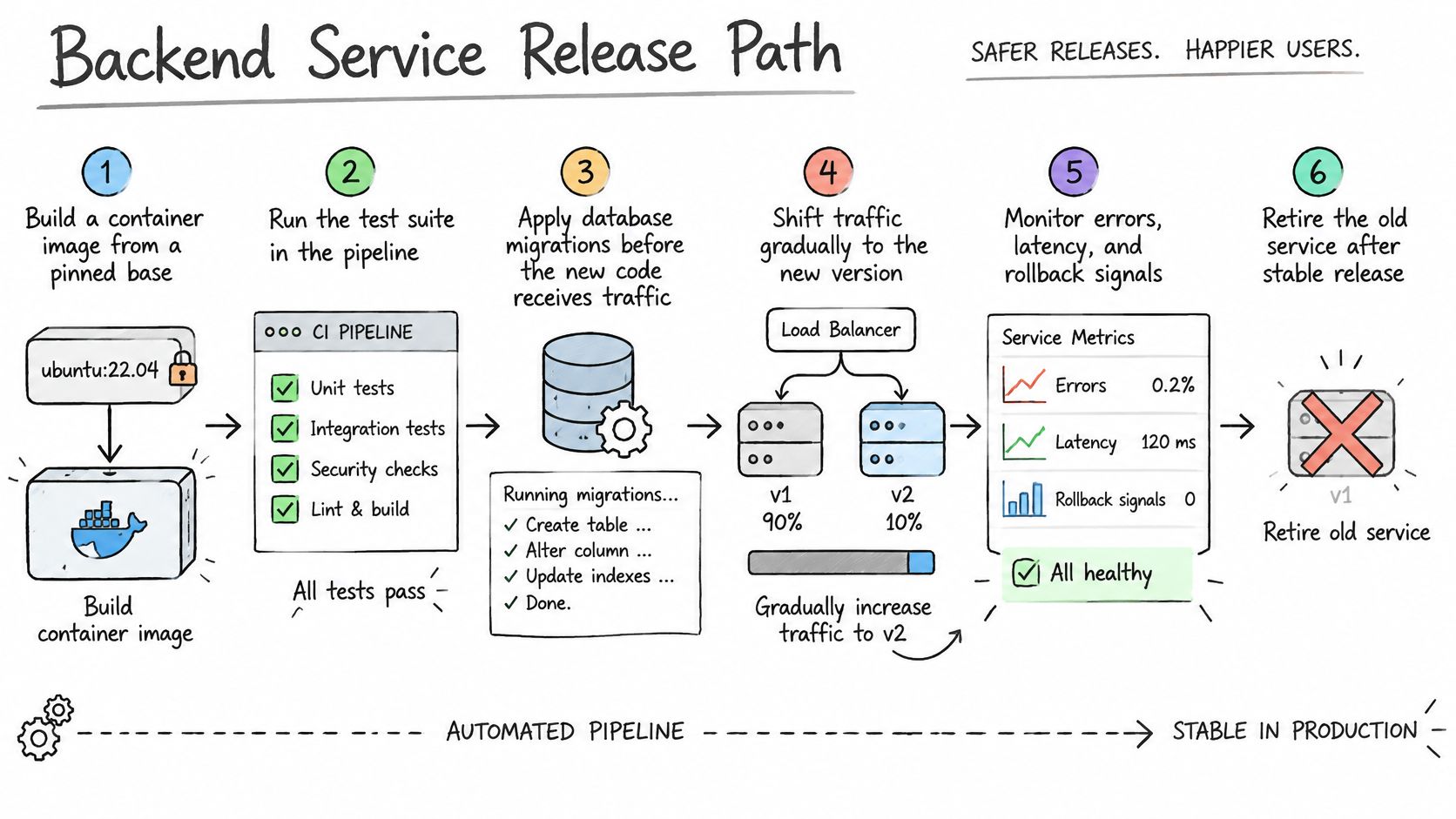
A release is a sequence, not a single push to a server.
- Build a container image from a pinned base so today's build matches next month's.
- Run the test suite in the pipeline. Unit tests cover business rules. Integration tests run against a disposable database container anyone on the team can recreate. Contract tests fail when a response drifts from the published API contract.
- Apply database migrations before the new code receives traffic, so the new process never reads a column that isn't there yet.
- Roll out gradually and check the health endpoint before you shift the rest of the traffic.
- Keep the previous version ready for rollback. A revert should be a traffic change, not a scramble to rebuild.
These thresholds are starting values. Tune them once you know your real traffic.
| Signal | What it tells you | Example alert threshold |
|---|---|---|
| Health check | The process accepts traffic | Fails three checks in a row |
| Error rate | Share of 5xx responses | Above 1% over 5 minutes |
| Database connections | Pool nearing its limit | Above 80% of the configured pool |
| Backup age | How much data a restore would lose | Older than 24 hours |
| Spend | Resources still billing | Above the set budget |
Retirement is part of the build
Most backend tutorials treat databases, queues, object storage, and AI services as permanent. Agent-driven work produces short-lived experiments whose resources keep charging after the code is abandoned. JFrog's 2025 software-supply-chain research reported that developers spend substantial time on secrets scanning, tying that time to weak secret handling and inefficient tooling. Automatic deletion is safer than leaving an experiment up forever, but only with an expiry warning, teardown that respects dependencies, an export path, and a control that promotes a resource to permanent.
Keep a list of every resource with an owner, a purpose, and an expiry date. Stop the application before you remove its database. Export or snapshot data before deletion, and test that a restore works. Credentials issued for those resources stay in a standard form, so you can take them to another host instead of being locked to the place that created them. A cloud database you can stand up for a prototype still needs that owner and end date on day one.
Say a prototype's Postgres instance and its storage bucket are still billing three weeks after the experiment ended, because nobody wrote down an owner. Before you create a resource, it has to answer two questions: who owns it, and when does it end?
Building Backends for Autonomous Coding Agents
An agent finishes a feature branch at 3 a.m., and by morning it has also created a database, an API key, and a storage bucket nobody approved. That is the new backend problem. The old question was how a user logs in. The new one is how a machine proves what it may touch, and how you cut it off.
Thales's 2025 global cloud-security study of 3,163 respondents found that 68% reported increased attacks using stolen credentials and secrets, while secrets management was the leading application-development security challenge. Industry reporting on AI-assisted development tells the same story from the other side: security issues introduced by generated code regularly slip through code review unnoticed. Handing an agent a developer's master key is where those two problems meet.
Controls that belong to the machine, not the person
- Give each agent run, or each machine, its own identity. Don't share a personal login.
- Scope every credential to one resource in one project. A key that can see every database is already too wide.
- Issue short-lived or rotatable secrets. A long-lived master key copied into a prompt will leak.
- Require a human approval gate before anything reaches production or starts billing. The approver signs in, picks a team and project, and sees every environment variable name and the price, so nobody copies a secret by hand.
- Record every operation in an immutable audit trail: who or what acted, when, and on which resource.
- Keep an emergency revocation path that cuts off one machine without touching the rest of the project.
Tight scoping is what makes the rest survivable. On ExtraOrbital, API keys are scoped to one team and optionally one project, and a project-scoped key gets a 403 for any other project. A leaked key then exposes one resource, not the whole account. Revoking that machine or rotating the project's secrets takes a click, because each credential was scoped to a single machine and resource from the start.
Two mechanics confuse teams here. First, the token exchange that turns an approval into credentials has to run on the app's server: its response carries no CORS headers, so a browser page cannot read it, which keeps the exchange out of client-side code entirely. Second, the approval gate only works if the human sees real information, which is why the connect screen shows every env var name and price before anything is created.
Engineering reviews the scope of each credential. Security reviews the audit trail and the revocation path. Both have to sign off before an agent run can create production resources.
Confirm Your Backend Plan Before You Write Code
Settle four decisions before the first handler exists.
Data shape decides the store. If you need transactions and stable relations, start with Postgres. If you need a cache or a session that can expire, add Redis for that job only.
Main clients decide the API style. A public mobile app and a partner integration point toward REST with versions. A mesh of internal workers points toward gRPC. A live dashboard points toward WebSocket.
Identity decides how users and machines authenticate, and where secrets live. Users get sessions or short-lived tokens. Agents get their own scoped credentials, not yours.
Deployment target, plus a retirement date, decides where the code runs and when a temporary database, bucket, or key disappears.
Run this in the next week:
- Name an owner for every resource already running.
- Write the API contract before the handlers, and freeze field meanings.
- Choose a backup and a restore-test date, and put both on a calendar.
- Set an expiry or a budget cap on each prototype so an abandoned experiment can't keep billing unnoticed.
For a prototype, we can supply a database, storage, and authentication from the command line, with no separate provider accounts to open first. An agent can provision in its own sandbox on a free allowance without an account, and a person can later claim the project. Free is for building, not production: it has no backups and no uptime guarantee. Moving to production should be a deliberate approval, not an accident of a successful demo.
Who owns this backend, and when does each part end? If you can't answer that, you aren't ready to ship.
ExtraOrbital provisions the databases, storage, authentication, and related services a backend needs, then writes connection details into the project so an agent or a developer can keep building. It also scopes machine credentials, records an audit trail, and can expire temporary resources instead of leaving them to bill. Visit ExtraOrbital and put an owner and an end date on the next backend you start.