Credit Card Pay as You Go: How Billing Works
Credit Card Pay as You Go explained: which cards qualify, how charges bill, what holds apply, and how to avoid interest and declines.
Your card is already saved in three dashboards. A database, a model API, a logging service. Each one bills a few dollars of usage, the charges land at different points in the month, and by the time the statement closes the total is larger than any single signup page suggested.
That's credit card pay as you go in practice: small recurring charges, one statement that aggregates them, and a due date that decides whether you pay nothing extra or start carrying interest. The card brand doesn't set your cost. How you settle the statement does.
Which Cards Work for Pay-as-You-Go Services
A card works for pay-as-you-go charges when the money to clear the full statement balance is available by the due date. Debit and prepaid work when the balance covers each charge as it arrives. Both patterns are legitimate, and they fail in different ways.
| Card type | Stored for recurring charges | Lends money | Reports to credit bureaus | Typical catch |
|---|---|---|---|---|
| Credit card | Yes | Yes, if a balance is carried | Yes | Interest applies to any balance carried past the due date |
| Debit card | Yes | No, draws on bank balance | Usually no | Declines or overdraft fees when the balance is short |
| Prepaid card | Often, some merchants refuse | No | Usually no | Balance must cover each charge, and holds reduce available funds |
| Charge card | Yes | No revolving balance | Yes | Full balance is due each month, with no grace on unpaid amounts |
| Secured credit card | Yes | Yes, backed by a deposit | Yes | Deposit ties up cash for the life of the card |
Credit cards sit at the centre of this because they're the default instrument for recurring billing. At the end of 2023, U.S. revolving credit passed $1.3 trillion, more than 25% of total consumer credit, and about 92% of those revolving balances were credit-card balances, according to Federal Reserve analysis of commercial-bank Call Report data. Ownership is just as broad: more than 75% of U.S. households owned at least one general-purpose credit card in 2019.
The reason pay-as-you-go cost depends on behaviour rather than brand is that a credit card is revolving credit by design. The issuer doesn't charge you for using it. It charges you for the part of the balance you leave unpaid when the statement comes due.
Where Charge Cards and Secured Cards Differ
A charge card removes the choice. The full balance is due each month and there's no revolving option, so an amount you don't pay doesn't roll forward at interest, it becomes past due. That's a discipline tool for some people and a trap for anyone with lumpy income.
Secured cards lend against a deposit that stays locked for the life of the account. The deposit is what makes approval possible, but it's also cash you can't spend while the card is open.
Rule of thumb: put a credit card on file only if you'll clear the full statement balance every cycle. If that isn't realistic yet, use debit or prepaid and accept that a short balance declines the charge instead of lending you the difference.
How a Pay-as-You-Go Charge Moves From Purchase to Payment
Say a developer tool bills $64 of usage on the 3rd of the month. Your statement closes on the 28th. The due date falls 21 days after that. Between the usage and the money leaving your account, five things happen, and only the last one is still under your control once the month is over.
The full sequence fits on one line.
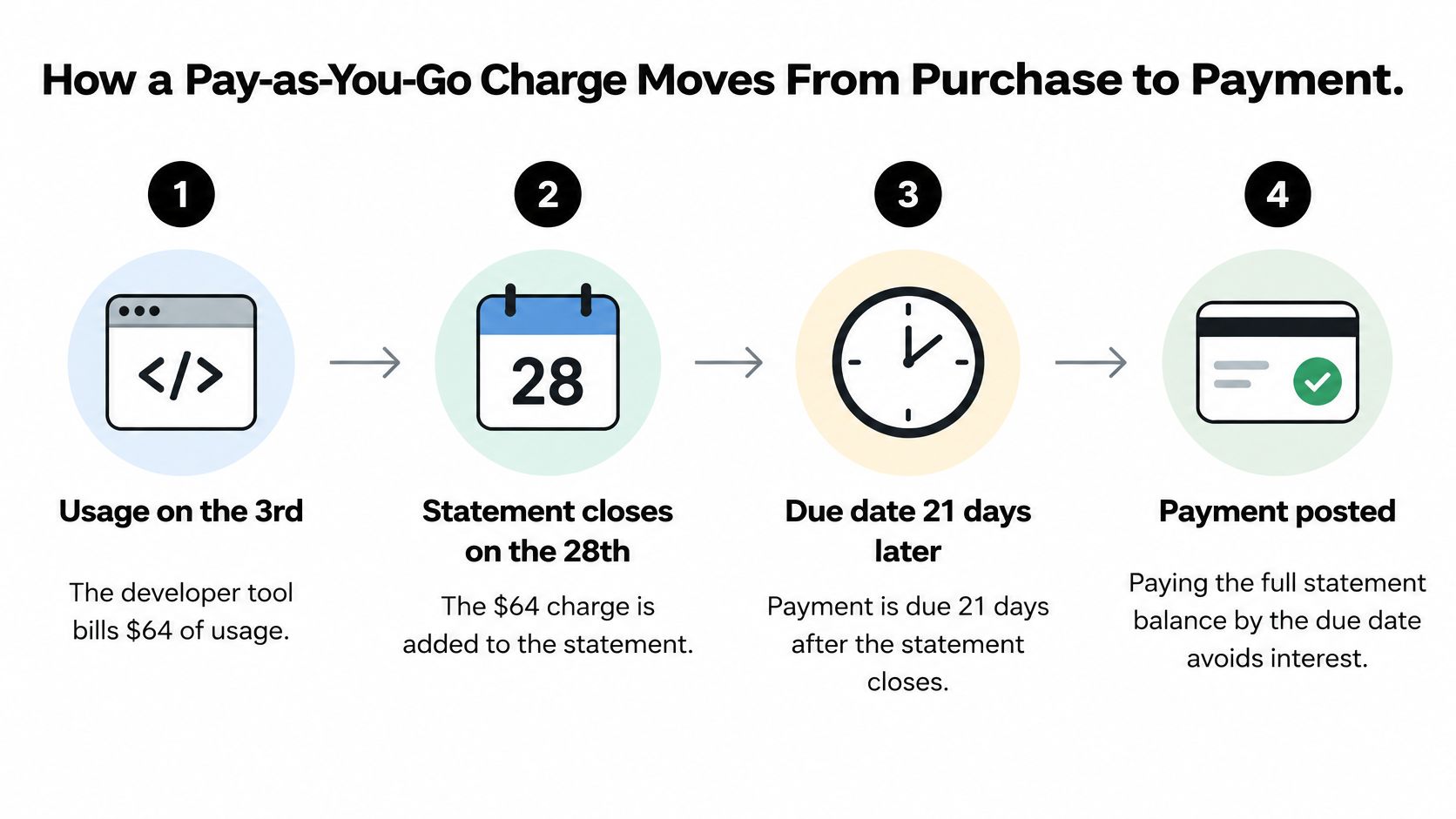
- Authorization. The service asks your issuer to reserve part of your credit limit. Nothing has posted yet, but available credit drops immediately. This is why a card can look full while the statement shows nothing.
- Posting. The merchant submits the final amount, often a day or two after the authorization and occasionally at a different figure. Currency conversion and metered overage can both move the number between the two steps.
- Statement close. On the 28th the cycle closes and the posted charge joins the statement balance. Charges that post after the close belong to the next statement, even if they happened on a day you were checking the app.
- Due date. Twenty-one days later, the minimum or the full statement balance has to post, not just be scheduled. A payment you initiate on the due date can land late.
- Payment recorded. The issuer applies it, the statement balance resets, and anything left over becomes a carried balance that starts accruing interest.
Statement Balance and Current Balance Aren't the Same Number
The statement balance is a snapshot taken at close. The current balance includes everything posted since, plus pending authorizations. Autopay, minimum due and the interest-free grace period all key off the statement figure, which is why paying "the current balance" can leave a small residue that starts interest anyway.
The distinction is old, and so is the behaviour behind it. The share of families with a bank-type card carrying an outstanding balance after their most recent payment rose from 6% in 1970 to 37% by 1995, according to the Federal Reserve Bulletin. Paying in full was once the norm. Revolving became routine once the infrastructure made it frictionless.
When the statement arrives, check three things on the line: the merchant name, the posting date, and whether the authorized amount matches the final charge. A hold that differs from the posted figure for a few days is normal. One that survives the cycle isn't.
Card Requirements and Holds for Metered Services
The card setup for a metered service behaves like a toll booth. Some lanes check nothing, some place a temporary reservation, and some charge the card before the service can continue. The question is not which card brand you use. It is when the provider moves money and what your issuer does while that happens.
| Service case | Card requirement | Typical hold or check | Why it matters |
|---|---|---|---|
| Free tier with no paid usage | None for the first team | None | The first team is free, needs no card, and usage stays within the free allowance |
| Postpaid team invoice | Card on file for any team beyond the first | Credit limit checked when the invoice runs | A limit already used by other spending can make the invoice fail |
| Prepaid credit top-up | Admin card charged at purchase | Authorization hold before the charge posts | Credit is added when the payment arrives |
| Metered usage with budget cap | Card on file | Hold of about the current usage estimate until the final amount posts | The hold can sit above the final charge until it releases |
| Enterprise or dedicated plan | Card or invoice agreement | Card authorization or invoice terms set the billing method and cycle | The agreement decides whether the charge posts to the card or runs through invoicing |
The free-tier row is easiest to understand. Your first team is on the Free plan and needs no card. Free allowances are shared across the whole account, so the allowance does not multiply for every resource. On the Free plan, the charged amount stays at zero while the allowance covers usage. On Pay-as-you-go and Enterprise, usage is charged from the first unit.
That difference catches people who assume every new resource gets its own free block. It does not. If Free usage is meant to cover a test, keep the account total in view instead of counting allowance resource by resource.
Postpaid invoices fail in a quieter way. The card is valid, the account is in good standing, and the invoice still declines because the credit limit is close to used by unrelated spending. The provider sees a failed payment and may suspend service. You see an outage.
Prepaid top-ups work in the opposite order. The card is charged at purchase, and the credit appears only once the payment arrives. An authorization can sit on the card while the account balance still shows no new credit. Treat the top-up as pending until the provider shows it.
On a paid prepaid team, spending is governed by a lifetime credit balance, plus a monthly window if a cap is set. On a paid postpaid team, the monthly budget cap is $500 if no cap is set. A budget cap gives you a stopping point. With the hard cap on, provisioning stops at the limit instead of charging past it.
Holds on metered usage are the most misread of the five. A merchant may reserve an estimated amount larger than the final charge, and the difference is not always released instantly. That can make a healthy card look overextended even when the final bill is small.
Recurring billing is now a large share of card traffic. Recurring and installment card payments grew roughly 19.8% annually from 2015 to 2018, reaching 5.8 billion payments in 2018, according to the Federal Reserve Payments Study. The study treats recurring payments as contract-based transactions, which tends to lower fraud exposure compared with ad hoc remote purchases, though they remain card-not-present charges.
Three Problems That Break the Setup
An expired card nobody updated. The number stays the same, the expiry does not, and the charge fails when the provider tries to bill.
A transaction flagged as card-not-present fraud. A new merchant, an unusual amount, or a billing address that does not match the issuer's records can block a charge you authorized.
An address mismatch after a move. You updated the delivery address and forgot the billing profile, and verification fails at the issuer.
Before creating a paid resource, confirm two things: whether the service charges from the first unit or only after a free allowance, and whether a card is required before an additional team is created. Any team beyond the first is pay-as-you-go and needs a card before it is created.
What Full, Minimum and Partial Payments Really Cost
A pay-as-you-go card is cheaper than borrowing only when you pay the full statement balance by the due date. That's the condition the phrase hides. Miss it and the card becomes a loan at card rates with none of the paperwork.
The three payment choices, side by side.
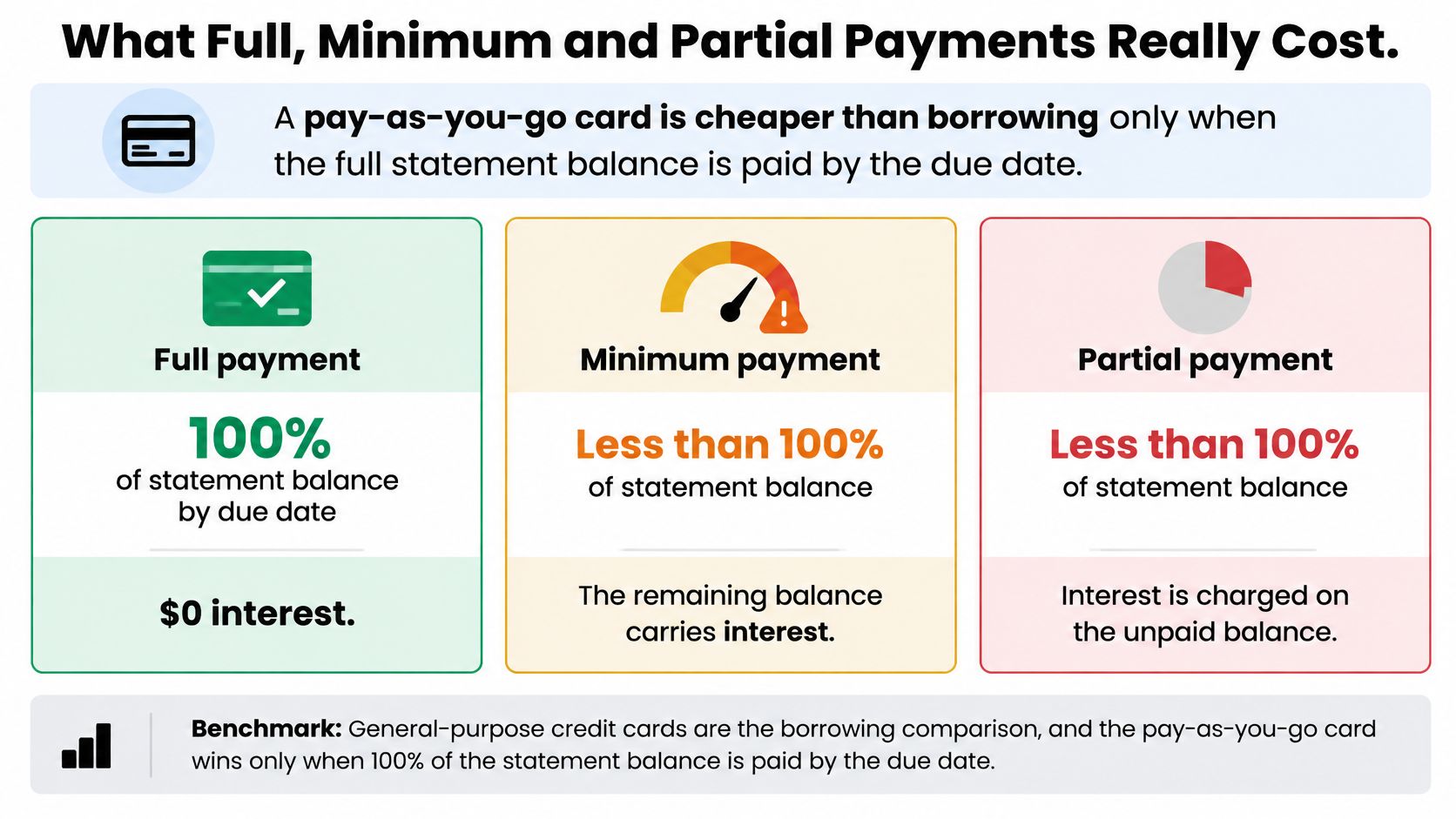
The benchmark for "card rates" is high. A comment filed in the CFPB's 2025 card-fee docket puts U.S. general-purpose card APR at an average of 25.2% in 2024, against 31.3% for private-label cards, and finds about 45% of U.S. card owners reported carrying a balance at least once during 2025. Hold onto that second number: a majority reported not carrying one, so full payment is the ordinary pattern, not an unusual act of discipline.
At 25.2%, a month of interest comes to roughly 2.1%. Carry $500 from one statement to the next and the interest is about $10.50. On a $64 usage bill, paying a month late adds a surcharge of around 16%.
| Payment choice | Interest or fee | Effect on balance | Watch for |
|---|---|---|---|
| Full statement balance by due date | No interest on purchases | Balance cleared each cycle | Missing the due date by a day can start interest |
| Minimum payment only | Interest on the unpaid balance at the card APR | Balance shrinks slowly | Interest and fees can take most of the payment |
| Partial payment above minimum | Interest on the unpaid part | Balance falls faster than minimum | Interest still applies to the carried part |
| Cash advance | Fee plus interest from the day of withdrawal | Balance grows immediately | Higher rate than purchases |
| Foreign-currency charge | Foreign transaction fee set by the issuer | Adds to statement balance | Fee applies even when the balance is paid in full |
The minimum payment keeps the account in good standing and does almost nothing else. It's built to cover the month's interest plus a sliver of principal, so a balance can survive for years while you pay on time every single month.
Paying in full isn't about willpower. It's a decision you make once a month against a number the issuer prints for you, and the arithmetic changes sharply the moment you decide the other way.
The cash advance deserves its own warning. Interest on a withdrawal typically starts the day the money leaves, not at the next statement, and a fee is charged on top. A cash advance to cover a card bill converts a payment problem into a more expensive one.
Comparison shopping works the same way. Separate the fixed fee from the metered part before judging which option is cheaper, which is what a managed services pricing breakdown lets you do line by line instead of guessing from the headline figure.
Monitoring Spending With Autopay, Limits and Alerts
Autopay is where a decent habit turns into an expensive one. Set it to the minimum and the account never goes delinquent, which removes every alarm that would otherwise tell you a balance is growing.
The numbers on that pattern aren't marginal. The share of general-purpose cardholders making only minimum payments reached 15% in 2024, and persistent debt, where at least half of a year's payments go to interest and fees, rose to 13% from 9.9% in 2022, per the 2025 Credit CARD Act review published by Orrick.
A Payment Order That Survives Variable Income
- Fund essentials from a separate account. Rent and utilities come out of an account that card autopay can't reach, so a billing error never turns into a housing risk.
- Hold a buffer equal to one month of pay-as-you-go spend. For a handful of small services that's a modest sum, and it's often the difference between paying in full and carrying a balance through a slow month.
- Schedule at least the minimum before the due date. This protects payment history, the part of your credit profile that a missed month damages most and takes longest to repair.
- Pay the rest, ideally the full statement balance, when cash allows. Extra payments during the cycle can lower the reported balance and free up room, but they don't erase interest on an amount you've already carried.
Automatic full-balance payment suits steady income and punishes irregular income, because it can pull cash you needed for something else. If your pay moves around, keep autopay at the minimum and make the full payment by hand once the month's cash is known.
Weekly Habits That Catch Drift Early
Check pending charges weekly. Anything stuck in pending for more than a few days is worth a call, and catching it early keeps it from landing on the statement as a surprise.
Set an alert at a percentage of the limit. Pick a level low enough to leave room to act before the balance is reported and before a large invoice has nowhere to clear.
Reconcile usage against the statement once a month. Open each service's usage view, compare it with the statement line, then cancel or cap whatever no longer earns its place.
Credit-score benefit comes from reported balances and payment history, not from the number of payments you make. Three payments in a month and one payment in a month can produce the same reported balance.
Fixing Declines, Duplicate Charges and Surprise Bills
Most billing problems show up as one of four symptoms. Each has a fix that takes minutes once you know which one you're looking at.
The common causes and the response that resolves them.
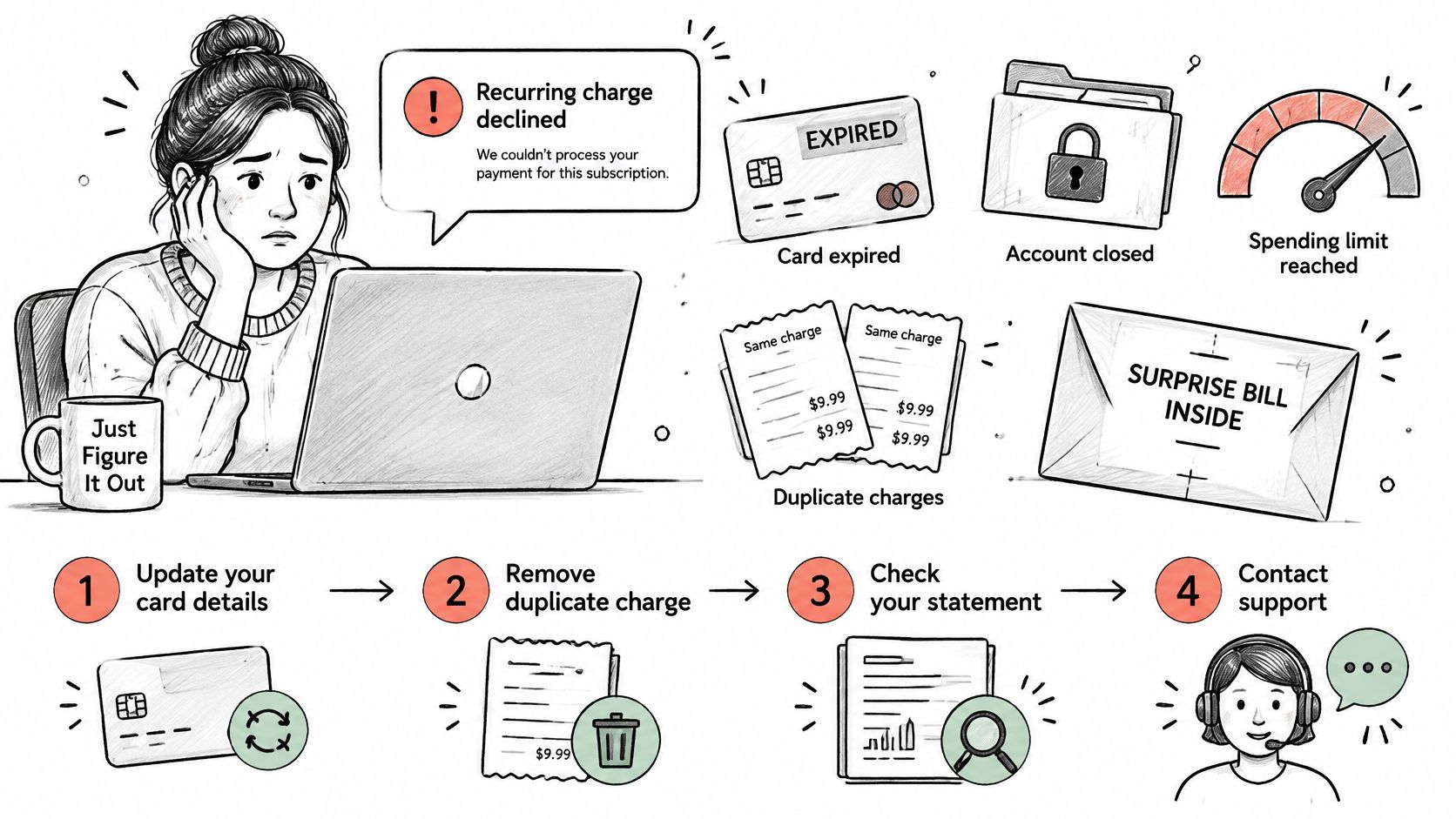
A recurring charge is declined. The usual cause is an expired card, a closed account, or a limit already committed elsewhere. Update the card on file, clear the balance so the limit is available, then retry rather than waiting for the next cycle, because a failed payment can suspend the service before the retry runs.
A duplicate charge appears after a retry. A hold from the first attempt can look like a second charge for several days. Check whether the original authorization has released. If it hasn't after a week, contact the merchant with both transaction IDs before disputing, since a dispute on a pending charge usually closes without action.
Watch the pattern, not just the single charge.
An unrecognised charge appears. Check whether another linked service or a teammate's machine is billing the account first. Real fraud is rare: Federal Reserve data on U.S. card payments put credit-card fraud at $17.13 per $10,000 in 2016, or 0.1713%, with 11.7 fraudulent payments per 10,000 transactions. Once you've ruled out your own services, dispute within the window the issuer allows rather than after the statement closes a second time.
A surprise bill appears after a free allowance ends. Open that service's usage view and compare it with the statement line. If it's a database you started on a free database plan and the allowance ran out, the charge is legitimate and the fix is a spending cap, not a dispute.
A declined charge can suspend a service the same day. Update cards before the expiry month and keep a backup payment method on file wherever the provider allows one.
Set Up Your Card for Pay-as-You-Go Today
Use a card you can pay in full by the due date. Set autopay to the full statement balance only when income is steady, and put a spending cap on every paid service that offers one.
- Card type chosen for the way you'll pay, not the rewards rate.
- Due-date reminder set three days before the statement is due.
- Autopay level decided and written down, minimum or full.
- Cap or alert configured on each service before the next cycle.
- First statement reconciled against the usage view.
As one example of terms worth comparing, our Pay-as-you-go plan costs $20 per member per month plus resource usage at supplier cost, needs a card before a team beyond the first is created, and applies a hard cap that stops provisioning at the limit rather than charging past it.
ExtraOrbital bills infrastructure usage at supplier cost with no markup, on one invoice across every resource, with budget caps per team and per key that stop provisioning at the limit instead of billing past it. You can start on the Free plan without a card and add billing only when a second team or persistent production resources need one. Visit ExtraOrbital to see how the usage ledger and caps line up with your next statement.